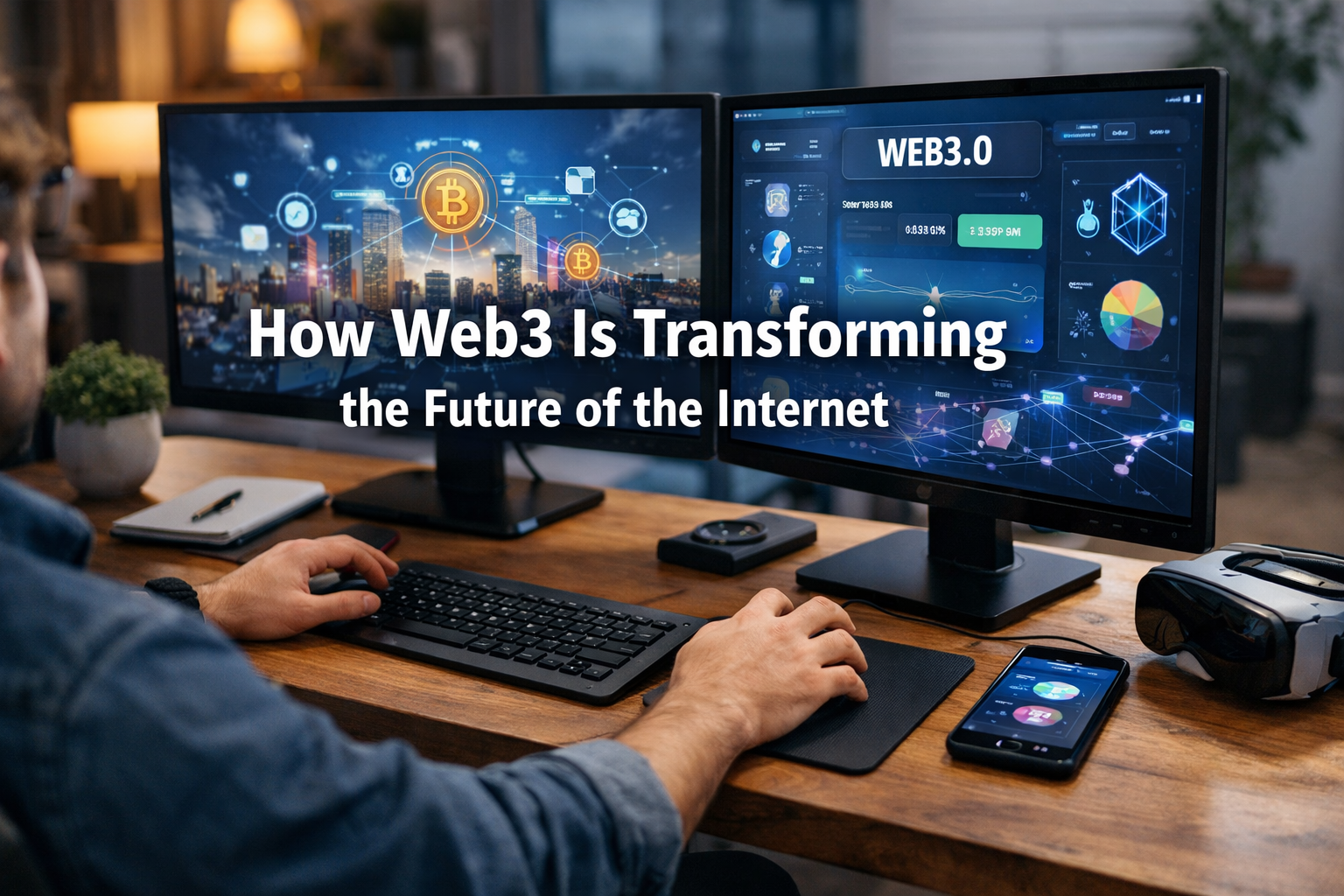
The Internet became accessible to the public in the 1990s, initially an idea that asked people to “imagine” the ways they could connect with others. Now, less than four decades later, it has changed so profoundly that no one back then could have predicted it. What started as static pages has evolved into social media platforms connecting billions, and now there’s web3, the decentralized form of the internet.
With the internet boom in the early 2000s, corporations grabbed control and started directing most of what happened online. Web3 works differently, though. It’s taking control back from tech giants and giving it to users through blockchain technology, so people can actually own their data and digital assets. This shift matters because it changes who has power online, and a lot of people think it’s the future of the internet.
Understanding the Evolution from Web1 to Web3
Web1 (Web 1.0) was the original internet from the 1990s and early 2000s – just static pages. You could only read websites. No posting comments, no uploading videos, no real-time chats, no interaction really. It was basically a giant digital library where you could browse but not add anything yourself.
Web2 changed that completely in the mid-2000s. Facebook launched. YouTube and Twitter came along. Suddenly, billions of people weren’t just consuming content anymore – they were making it. But here’s the thing: before most people realized what was happening, corporations had already taken over. All that interaction was happening on platforms owned by tech companies. They controlled the servers; they controlled the data. Privacy became a huge problem as these companies collected and sold massive amounts of user information. User data itself turned into a multi-billion dollar business.
The internet is still mostly Web2 today, but Web3 has gotten really popular in the past decade because it fixes the centralization problems of Web2. Web3 runs on blockchain instead of centralized servers. Your data doesn’t sit in some company’s data center – it’s distributed across a network of computers that no single company controls. You can move between different services with one account, and everything you do gets recorded on the blockchain. It’s visible to everyone, but you’re the one in control.
Web3 Domains: A New Approach to Digital Identity
The standout feature of Web3 is Web3 domains; they are truly transforming what the meaning of ownership of digital assets and identities is by enabling decentralised blockchain-based ownership rather than renting them from centralized providers.
If you’re wondering what is the main purpose of Web3 domains, the answer lies in digital ownership: they allow individuals to fully control their online identity and assets without relying on centralized registrars. When you register a regular .com or .org domain, you don’t really own it but rent it year after year from a registrar. They can take it away if you violate the terms of service or if you forget to renew. It’s a recurring cost with the least amount of control.
Web3 domains like .crypto, .eth, and .nft are different. When you buy web3 domains, they become NFTs in your crypto wallet with full ownership outright that nobody can revoke.
They also solve several practical problems, i.e., cryptocurrency wallet addresses look like this: 0xf7005e56457E6E9DE690cbD9F4F68b50804Ddc91. That’s impossible to remember and easy to mistype, but Web3 domains let you replace that mess with something simple like “yourname.crypto.” Much easier.
Platforms like Freename let you register these domains with a very straightforward process. Once you own one, it serves as your digital identity across the entire web3 ecosystem.
Real-World Applications of Web3
DeFi (decentralized finance) is probably the biggest web3 application right now. People lend money to each other without banks or centralised institutions involved. They trade cryptocurrencies and earn royalties or interest through smart contracts, which are programs that execute automatically when conditions are met. No loan officers. No credit checks in the traditional sense. Just code.
Gaming has also adopted Web3, and players can actually own their in-game items as NFTs. If you earn a rare sword in one game, you can sell it and might even use it in a different game if developers allow cross-platform assets. This creates real economies around virtual items.
The metaverse concept expands on this. Virtual worlds where you can work, play, and socialize. Some people have already bought virtual real estate in these spaces, betting that digital property will increase in value.
Web3 domains can act like a universal username across the entire decentralized internet. It replaces your complicated crypto wallet address with something simple like “john.crypto” that you can use for sending or requesting payments, logging into apps, gaming, and the metaverse. Since it’s stored as an NFT in your wallet, you own it permanently – nobody can take it away.
What’s Ahead for Web3
Regulators still haven’t figured out how to deal with this advanced form of the internet, and rules vary wildly between countries. That uncertainty makes businesses nervous.
As Web3 is becoming more popular over time, it needs much simpler interfaces before regular users will adopt it. But in the yesteryears, there were massive improvements with many innovative services stepping into the market, simplifying the user experience.
Despite these concerns, this side of the internet is booming. The global web3 market is worth billions, and analysts project 50% annual growth through 2030. Big companies are testing hybrid models that mix Web2 and Web3 features.
Maybe the future internet won’t be purely decentralized or centralized. It might blend both approaches. Either way, web3 has already changed the conversation about who owns what online. That alone makes it worth watching.
