
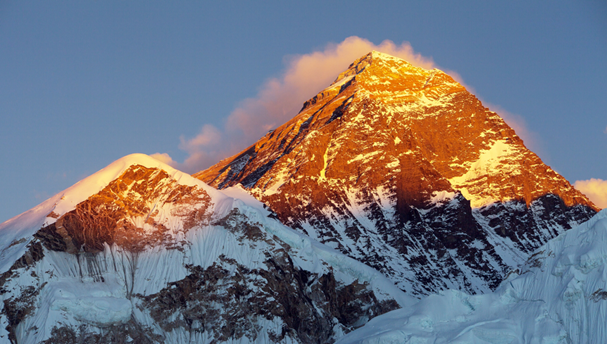
Mention Nepal and one image almost immediately comes to mind: Mount Everest.
Rising above the Himalayas to 29,032 feet (8,849 m), Mount Everest is the highest point on Earth and one of the Seven Natural Wonders of the World. It is Nepal’s most recognizable natural landmark and one of the great adventure destinations on the planet. For generations, climbers, trekkers, photographers, and dreamers have been drawn to its slopes simply for the opportunity to stand in the presence of the world’s highest mountain.
But Everest tells only part of Nepal’s story.
Travel south from the Himalayas and the landscape changes dramatically. Snow and rock give way to forests, river valleys, wetlands, grasslands, and subtropical jungle. Nepal is a country where travelers can spend one week looking toward some of the world’s highest summits and another searching tall grass for a greater one-horned rhinoceros.
Eight of the world’s fourteen mountains above 8,000 meters rise in Nepal, yet the country also protects remarkably diverse wildlife and ecosystems across its national parks and protected areas.
For travelers who love nature, Nepal deserves to be experienced as more than a mountain destination. Three national parks in particular reveal just how extraordinary the country can be.
Sagarmatha National Park: Walk Beneath the World’s Highest Mountains
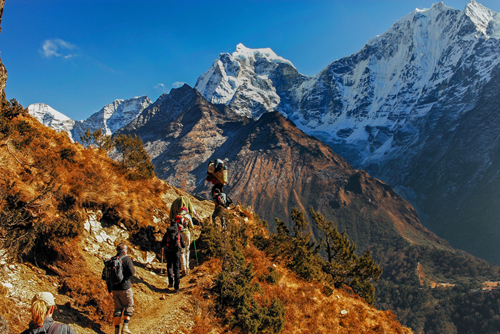
There is no better place to begin than Sagarmatha National Park.
Located in northeastern Nepal, this UNESCO World Heritage Site protects 1,148 square kilometers of the Himalayas and includes Mount Everest itself. But the park is much more than the mountain at its center. Deep valleys, glaciers, rushing rivers, forests, villages, monasteries, and an extraordinary collection of Himalayan peaks create one of the world’s great trekking landscapes.
For most travelers, the best way to experience Sagarmatha isn’t by attempting to climb Everest. It is by walking.
The trail toward Everest Base Camp allows visitors to experience the Himalayas gradually. From Lukla, trekkers move through mountain villages and forests before climbing toward Namche Bazaar and eventually into increasingly dramatic alpine terrain. Every day brings another perspective—suspension bridges over rushing rivers, distant snow-covered summits, prayer flags moving in the wind, and small communities tucked into seemingly impossible landscapes.
Wildlife can include Himalayan tahr, musk deer, ghoral, Himalayan monal, and, for the exceptionally fortunate observer, the elusive snow leopard.
Yet Sagarmatha is also a cultural landscape. Spending time in Sherpa communities and visiting places such as Tengboche Monastery gives the journey a dimension that simply photographing Everest cannot provide.
The best approach is to slow down. Allow enough time for acclimatization, stay in local tea houses, walk with a knowledgeable local guide, and experience the communities along the trail rather than treating them merely as stops on the way to Base Camp. October and November and March through May are generally considered the best trekking periods.
Everest may be the destination people recognize, but the journey through Sagarmatha is what many travelers remember.
Chitwan National Park: Discover Nepal’s Wild Side
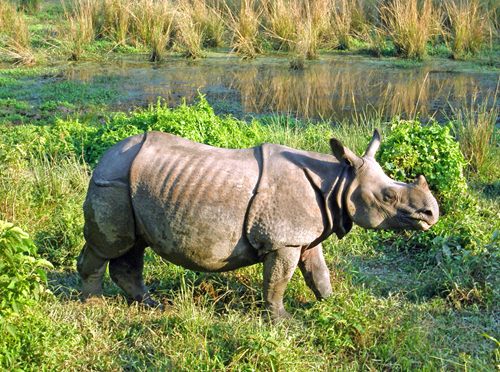
After experiencing Nepal’s mountains, Chitwan National Park can feel like arriving in another country.
Instead of glaciers and alpine valleys, visitors encounter sal forests, grasslands, wetlands, floodplains, and winding rivers. Chitwan lies in Nepal’s subtropical Terai and was designated a UNESCO World Heritage Site in 1984.
This is safari country.
Chitwan is one of the best places in Nepal to encounter the greater one-horned rhinoceros. Bengal tigers also inhabit the park, although sightings are far less predictable. Leopards, sloth bears, deer, monkeys, wild boar, gharials, mugger crocodiles, and an impressive diversity of birds add to the experience.
The best way to discover Chitwan is through several different perspectives. Take an early-morning guided nature walk when the forest is coming alive. Explore deeper areas by jeep with an experienced naturalist. A canoe trip along the Rapti River offers an entirely different experience, particularly for observing crocodiles and waterbirds. Birdwatchers should carry binoculars; hundreds of bird species have been recorded in the park.
Travelers should also make time to learn about the indigenous Tharu communities of the region. Nature and culture are closely connected here, and engaging respectfully with local communities adds another layer to understanding the landscape.
Rather than racing through Chitwan in a single day, spend two or three nights. Give the jungle time to reveal itself. Wildlife encounters are rarely scheduled, and sometimes the most memorable moment comes when nothing seems to be happening—until suddenly something moves in the grass.
Bardiya National Park: Go Deeper into Wild Nepal
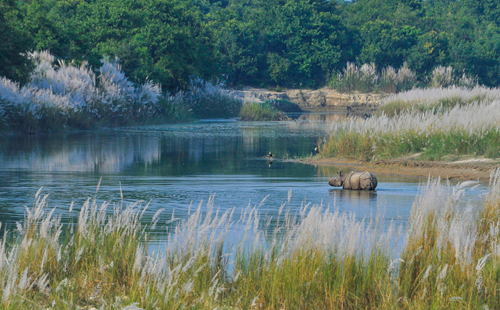
For travelers wanting something quieter and more remote, Bardiya National Park offers perhaps Nepal’s greatest wilderness surprise.
Located in the western Terai, Bardiya protects a landscape of sal forest, savanna, grassland, and river habitat. It is home to Bengal tigers, greater one-horned rhinoceroses, Asian elephants, swamp deer, gharials, and an extraordinary variety of birdlife. The Karnali River also provides habitat for the endangered Gangetic river dolphin.
Bardiya feels different from Nepal’s better-known destinations. Its relative remoteness is part of the attraction.
This is a place to stay several days, rise early, and explore with trained local naturalists. Guided jungle walks can provide an intimate experience of the landscape, while jeep safaris allow travelers to cover larger areas in search of wildlife. Exploring the river adds yet another perspective.
Tiger sightings are never guaranteed, and that is exactly how a genuine wilderness experience should be. Bardiya isn’t a zoo. The excitement comes from tracks in the soil, alarm calls in the forest, movement along a distant riverbank, and the realization that somewhere nearby a tiger may be moving unseen through the grass.
For travelers primarily interested in wildlife, October through March offers favorable conditions, while the hotter months approaching summer can also produce rewarding wildlife encounters around water sources.
Nepal Beyond Everest
Mount Everest deserves its place among the world’s great natural wonders. Standing beneath it—or simply seeing it appear above the Himalayas—is an experience capable of redefining a person’s sense of scale.
But Nepal should never be reduced to a single mountain. This is a country where you can trek beneath the world’s highest peaks in Sagarmatha, watch a rhinoceros emerge from the grasslands of Chitwan, and search the forests of Bardia for one of the world’s most magnificent predators.
The remarkable thing about Nepal isn’t simply how high the country rises. It is how much nature exists between the jungle and the summit.
Come to Nepal because of the mountain if you wish. Just don’t leave without discovering everything beyond it.
