
One decimal point on an emissions worksheet. That’s all it takes to turn an eighty-cent gallon into an eight-cent one. Producers are figuring this out the hard way under the 45z tax credit, where your payout isn’t locked in by statute. It’s calculated. Feedstock by feedstock. Through something called the 45ZCF-GREET model.
If you thought clean fuel incentives were flat-rate, this program rips up that playbook.
Here’s the part most producers trip over. The credit isn’t really about the fuel you’re making. It’s about the carbon intensity score you drag along with it. That score is where the real money lives, and where most of it gets lost.
Why GREET Ended Up Running the Show
Treasury didn’t pull GREET out of a hat. Argonne National Laboratory built it to track lifecycle greenhouse gas emissions across every stage of a fuel’s journey, from the field all the way to the pump. When Congress dropped Section 45Z into the Inflation Reduction Act, someone needed a defensible way to reward cleaner fuels without hand-picking winners. GREET got the job.
The math looks simple on paper. You take the maximum credit, either $1.00 per gallon for regular transportation fuel or $1.75 for sustainable aviation fuel, and multiply it by an emissions factor. That factor slides between zero and one, depending on your carbon intensity score (CI, if you want the shorthand). The ceiling sits at 50 kgCO2e/mmBtu. Cross it, and you walk away with nothing.
That threshold ends up mattering way more than the headline dollar figure.
Feedstock Is Doing the Heavy Lifting
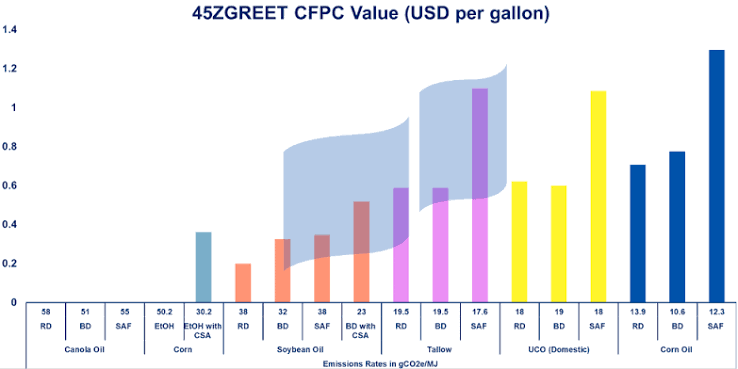
Two producers can pour out the exact same gallon of renewable diesel and end up with wildly different 45z tax credit checks. Same product, same specs, totally different outcome. Why does that happen? Because the feedstocks they started with didn’t enter the GREET model on equal footing.
Used cooking oil shows up almost clean. It’s a waste stream, already produced for other reasons, so the model gives it minimal upstream baggage. Tallow works similarly. These low-CI feedstocks tend to score in the teens or lower, which pulls the credit close to its ceiling.
Virgin vegetable oils are a different animal. Soybean oil carries emissions from farming, fertilizer runs, land use assumptions, processing energy. Canola isn’t far behind. Their CI scores climb higher, sometimes bumping right up against that 50-point cliff.
The gap isn’t small either.
| Feedstock | Typical CI Range (kgCO2e/mmBtu) | Estimated 45z Value per Gallon (Non-SAF) |
| Used cooking oil | 15 to 25 | $0.50 to $0.70 |
| Tallow | 20 to 30 | $0.40 to $0.60 |
| Soybean oil | 40 to 55 | $0.00 to $0.20 |
| Canola oil | 35 to 50 | $0.00 to $0.30 |
| Corn oil (distillers) | 25 to 40 | $0.20 to $0.50 |
Ranges shift based on your facility, your region, and the assumptions baked into your process model. But the pattern doesn’t budge. Waste and residual streams win. Virgin crops scrap for every point they can get.
The Value Swing Nobody Bothered to Price In
Picture a 50-million-gallon-per-year plant. Shift from a mid-30s soybean pathway to a low-20s tallow pathway, and you’re staring at roughly $15 to $25 million in annual credit value swinging one way or the other. That’s not a rounding error anyone can absorb. That’s the line between a project that pencils out and one that quietly dies in committee.
Refineries running blended slates are already back at the whiteboard. Some are locking down long-term contracts with rendering plants and grease collectors before prices catch up. Others are chasing carbon-smart farming, cover cropping, reduced tillage, precision fertilizer application, trying to shave points off crop-based CI scores.
The 45z tax credit rewards those moves. It punishes anyone still coasting on last year’s assumptions.
Where Producers Keep Getting Blindsided
Three blind spots keep tripping up real projects.
Indirect land use change is the first one. Crop-based feedstocks carry an ILUC penalty inside GREET that catches producers off guard, especially if they were benchmarking against older LCFS-style pathways. That penalty by itself can shove soybean oil past the credit threshold in certain setups.
Hydrogen sourcing is the second. If your renewable diesel or SAF process runs on grey hydrogen, those upstream emissions leak straight into your final CI. Producers looking hard at blue or green hydrogen aren’t chasing press releases. They’re protecting the arithmetic behind their 45z tax credit.
Provisional emissions rates round out the trio. For pathways that haven’t landed in the published table yet, producers have to file for a PER. That takes time. And until Treasury nails down final guidance, uncertainty starts pricing itself into every term sheet.
Conclusion
The producers pulling ahead treat CI scoring as a design input, not a post-hoc calculation. They’re running multiple feedstock scenarios before capital gets committed. They’re negotiating supply agreements with CI performance clauses written into the contract. They’re pulling in tax and technical advisors early, well before the first gallon hits a storage tank.
If you want a closer look at where the rules are actually heading, the proposed regulations under Section 45Z walk through how Treasury plans to handle feedstock certification, registration timelines, and everything in between.
The 45z tax credit isn’t really a subsidy. It’s a scoreboard. Producers who understand how the scoring works keep the value. Everyone else hands it over to competitors who bothered to run the numbers.45z Tax Credit Emissions Scoring: How the GREET-Based Rate Swings Value Between Feedstocks
One decimal point on an emissions worksheet. That’s all it takes to turn an eighty-cent gallon into an eight-cent one. Producers are figuring this out the hard way under the 45z tax credit, where your payout isn’t locked in by statute. It’s calculated. Feedstock by feedstock. Through something called the 45ZCF-GREET model.
If you thought clean fuel incentives were flat-rate, this program rips up that playbook.
Here’s the part most producers trip over. The credit isn’t really about the fuel you’re making. It’s about the carbon intensity score you drag along with it. That score is where the real money lives, and where most of it gets lost.
Why GREET Ended Up Running the Show
Treasury didn’t pull GREET out of a hat. Argonne National Laboratory built it to track lifecycle greenhouse gas emissions across every stage of a fuel’s journey, from the field all the way to the pump. When Congress dropped Section 45Z into the Inflation Reduction Act, someone needed a defensible way to reward cleaner fuels without hand-picking winners. GREET got the job.
The math looks simple on paper. You take the maximum credit, either $1.00 per gallon for regular transportation fuel or $1.75 for sustainable aviation fuel, and multiply it by an emissions factor. That factor slides between zero and one, depending on your carbon intensity score (CI, if you want the shorthand). The ceiling sits at 50 kgCO2e/mmBtu. Cross it, and you walk away with nothing.
That threshold ends up mattering way more than the headline dollar figure.
Feedstock Is Doing the Heavy Lifting
Two producers can pour out the exact same gallon of renewable diesel and end up with wildly different 45z tax credit checks. Same product, same specs, totally different outcome. Why does that happen? Because the feedstocks they started with didn’t enter the GREET model on equal footing.
Used cooking oil shows up almost clean. It’s a waste stream, already produced for other reasons, so the model gives it minimal upstream baggage. Tallow works similarly. These low-CI feedstocks tend to score in the teens or lower, which pulls the credit close to its ceiling.
Virgin vegetable oils are a different animal. Soybean oil carries emissions from farming, fertilizer runs, land use assumptions, processing energy. Canola isn’t far behind. Their CI scores climb higher, sometimes bumping right up against that 50-point cliff.
The gap isn’t small either.
| Feedstock | Typical CI Range (kgCO2e/mmBtu) | Estimated 45z Value per Gallon (Non-SAF) |
| Used cooking oil | 15 to 25 | $0.50 to $0.70 |
| Tallow | 20 to 30 | $0.40 to $0.60 |
| Soybean oil | 40 to 55 | $0.00 to $0.20 |
| Canola oil | 35 to 50 | $0.00 to $0.30 |
| Corn oil (distillers) | 25 to 40 | $0.20 to $0.50 |
Ranges shift based on your facility, your region, and the assumptions baked into your process model. But the pattern doesn’t budge. Waste and residual streams win. Virgin crops scrap for every point they can get.
The Value Swing Nobody Bothered to Price In
Picture a 50-million-gallon-per-year plant. Shift from a mid-30s soybean pathway to a low-20s tallow pathway, and you’re staring at roughly $15 to $25 million in annual credit value swinging one way or the other. That’s not a rounding error anyone can absorb. That’s the line between a project that pencils out and one that quietly dies in committee.
Refineries running blended slates are already back at the whiteboard. Some are locking down long-term contracts with rendering plants and grease collectors before prices catch up. Others are chasing carbon-smart farming, cover cropping, reduced tillage, precision fertilizer application, trying to shave points off crop-based CI scores.
The 45z tax credit rewards those moves. It punishes anyone still coasting on last year’s assumptions.
Where Producers Keep Getting Blindsided
Three blind spots keep tripping up real projects.
Indirect land use change is the first one. Crop-based feedstocks carry an ILUC penalty inside GREET that catches producers off guard, especially if they were benchmarking against older LCFS-style pathways. That penalty by itself can shove soybean oil past the credit threshold in certain setups.
Hydrogen sourcing is the second. If your renewable diesel or SAF process runs on grey hydrogen, those upstream emissions leak straight into your final CI. Producers looking hard at blue or green hydrogen aren’t chasing press releases. They’re protecting the arithmetic behind their 45z tax credit.
Provisional emissions rates round out the trio. For pathways that haven’t landed in the published table yet, producers have to file for a PER. That takes time. And until Treasury nails down final guidance, uncertainty starts pricing itself into every term sheet.
Conclusion
The producers pulling ahead treat CI scoring as a design input, not a post-hoc calculation. They’re running multiple feedstock scenarios before capital gets committed. They’re negotiating supply agreements with CI performance clauses written into the contract. They’re pulling in tax and technical advisors early, well before the first gallon hits a storage tank.
If you want a closer look at where the rules are actually heading, the proposed regulations under Section 45Z walk through how Treasury plans to handle feedstock certification, registration timelines, and everything in between.
The 45z tax credit isn’t really a subsidy. It’s a scoreboard. Producers who understand how the scoring works keep the value. Everyone else hands it over to competitors who bothered to run the numbers.
