
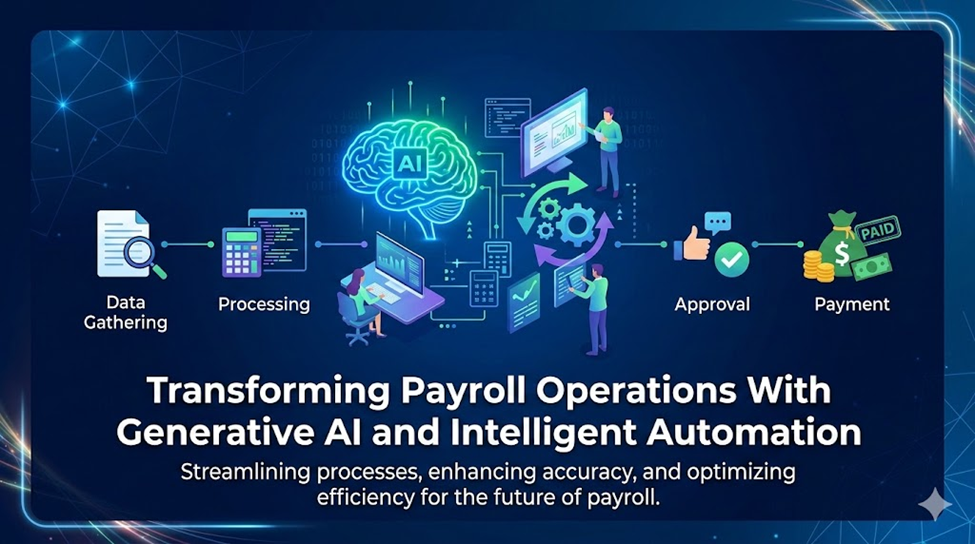
Payroll is one of the most critical operational functions within any organization. It ensures employees are paid accurately and on time while maintaining compliance with complex tax regulations, labor laws and reporting requirements. Despite its importance, payroll operations often rely on manual processes, fragmented systems and repetitive administrative tasks.
Generative AI is emerging as a powerful technology that can transform payroll management by automating routine activities, improving accuracy and enhancing decision support. As organizations modernize their HR and finance operations, AI-driven capabilities are becoming an essential component of broader digital transformation initiatives.
Many enterprises are now exploring how generative AI can streamline payroll operations, improve compliance and deliver better employee experiences. Implementing these technologies effectively requires structured expertise, which is why many organizations turn to specialized advisors offering AI consulting services to guide strategy, governance and implementation.
Overview of Gen AI in payroll
Generative AI refers to advanced artificial intelligence models capable of producing human-like outputs such as text summaries, reports, recommendations and automated responses based on large volumes of data. Within payroll operations, these capabilities can help automate data analysis, documentation, compliance checks and employee support interactions.
Payroll environments are highly data-intensive and involve numerous variables, including compensation structures, tax rules, deductions, benefits and regional compliance requirements. Generative AI can analyze these datasets quickly, identify inconsistencies and generate insights that improve operational efficiency.
The adoption of Gen AI in Payroll is gaining momentum as organizations seek ways to modernize HR operations and reduce administrative overhead. Rather than replacing payroll professionals, generative AI acts as a digital assistant that enhances their ability to manage complex processes.
By integrating generative AI into payroll platforms and workflows, organizations can create more intelligent and adaptive payroll systems that support accuracy, compliance and scalability.
Benefits of Gen AI in payroll
Increased operational efficiency
Payroll teams often spend significant time on repetitive tasks such as data validation, report generation and responding to employee inquiries. Generative AI can automate many of these activities by generating reports, summarizing payroll records and drafting responses to common employee questions.
This automation allows payroll professionals to focus on higher-value responsibilities such as policy oversight, compliance management and strategic workforce planning.
Improved accuracy and reduced errors
Payroll errors can lead to employee dissatisfaction, regulatory penalties and reputational damage. Generative AI can analyze payroll data in real time, detect inconsistencies and flag potential issues before payroll processing is finalized.
Automated checks improve data accuracy and reduce the likelihood of errors caused by manual entry or complex calculations.
Enhanced compliance management
Payroll operations must comply with constantly evolving tax regulations, employment laws and reporting requirements across multiple jurisdictions. Generative AI can assist in monitoring regulatory updates, summarizing compliance requirements and generating documentation for audits.
This capability helps payroll teams stay up to date with regulatory changes and reduces the risk of noncompliance.
Better employee experience
Employees frequently have questions related to payslips, tax deductions, benefits and payroll timelines. AI-powered assistants can quickly and accurately respond to these inquiries by referencing payroll policies and records.
Providing instant, reliable responses improves transparency and strengthens employee trust in payroll systems.
Faster reporting and insights
Payroll data provides valuable insights into workforce costs, compensation trends and labor budgeting. Generative AI can analyze payroll datasets and generate summaries that support financial planning and HR decision-making.
These insights enable leadership teams to understand workforce spending better and optimize resource allocation.
Use cases of Gen AI in payroll
Automated payroll reporting
Payroll summaries and financial reports
Generative AI can automatically produce payroll summaries, compensation reports and cost analysis documents based on payroll data. These reports can be generated quickly and customized for HR leaders, finance teams and executives.
Audit documentation preparation
Payroll audits often require extensive documentation and data reconciliation. Generative AI can compile relevant records and generate summaries that simplify audit preparation.
Employee payroll support
AI-powered payroll assistants
Generative AI can power conversational assistants that answer employee questions about pay statements, tax deductions and benefits. These assistants can provide accurate responses using internal payroll policies and historical data.
Pay slip explanations
Employees may find payroll statements difficult to interpret. Generative AI can generate simplified explanations of pay slip components, helping employees better understand their compensation.
Payroll data validation
Error detection and anomaly identification
Generative AI models can analyze payroll datasets to detect anomalies such as incorrect tax calculations, duplicate payments or inconsistent deductions. Early identification helps payroll teams resolve issues before payroll processing is completed.
Data reconciliation
Payroll operations often involve integrating information from multiple HR and finance systems. Generative AI can reconcile datasets and highlight discrepancies between records.
Compliance and regulatory monitoring
Regulatory updates analysis
Generative AI can analyze regulatory updates related to payroll taxation and employment law. The technology can summarize key changes and generate recommendations for payroll teams.
Policy documentation
Payroll policies and compliance guidelines require frequent updates. Generative AI can assist in drafting policy documents and maintaining clear documentation.
Workforce cost analytics
Compensation trend analysis
Payroll data contains valuable insights about compensation structures and workforce costs. Generative AI can analyze trends and generate summaries that support HR and finance planning.
Budget forecasting support
By analyzing payroll data alongside workforce planning inputs, generative AI can help forecast labor costs and compensation budgets.
Why choose The Hackett Group® for implementing Gen AI in payroll
Successfully implementing generative AI in payroll requires more than deploying new technology. Organizations must establish governance frameworks, align AI initiatives with business objectives and ensure responsible data usage.
The Hackett Group® is widely recognized for its research-driven insights and benchmarking expertise across enterprise functions, including HR and finance. Its advisory approach helps organizations adopt generative AI in a disciplined and value-focused manner.
Benchmark-based transformation strategy
The Hackett Group® leverages extensive benchmarking research to identify performance gaps and prioritize AI initiatives that deliver measurable results. This data-driven methodology ensures that generative AI investments are aligned with operational improvement goals.
Structured implementation and governance
Deploying generative AI in payroll requires careful consideration of compliance, data privacy and risk management. A structured implementation framework ensures that organizations adopt AI responsibly while maintaining regulatory compliance.
Integration with enterprise transformation initiatives
Generative AI initiatives are most effective when aligned with broader digital transformation programs. The Hackett Group® helps organizations integrate AI capabilities into their HR and payroll operating models, enabling sustainable long-term improvements.
Practical guidance and scalable deployment
Organizations benefit from practical guidance that spans use case identification, pilot implementation and enterprise scaling. This approach helps payroll teams adopt generative AI technologies with confidence and measurable impact.
The Hackett AI XPLR™ platform further supports organizations by enabling leaders to explore, evaluate and prioritize AI use cases across enterprise functions. It provides structured insights that help accelerate the adoption of generative AI solutions.
Conclusion
Payroll operations are evolving as organizations seek greater efficiency, compliance and transparency. Generative AI offers powerful capabilities that can automate administrative tasks, improve payroll accuracy and provide deeper insights into workforce costs.
By integrating generative AI into payroll processes, organizations can reduce operational complexity, enhance employee experiences and support more strategic workforce planning. These benefits make generative AI an important component of modern HR and finance transformation efforts.
However, achieving sustainable value requires careful planning, governance and alignment with enterprise objectives. Organizations that take a structured approach to generative AI adoption will be better positioned to modernize payroll operations and drive long-term performance improvements.
As generative AI technologies continue to mature, payroll functions will become more intelligent, data-driven and responsive. Enterprises that invest in the right strategies and expertise today will gain a competitive advantage in managing workforce operations efficiently and effectively.
