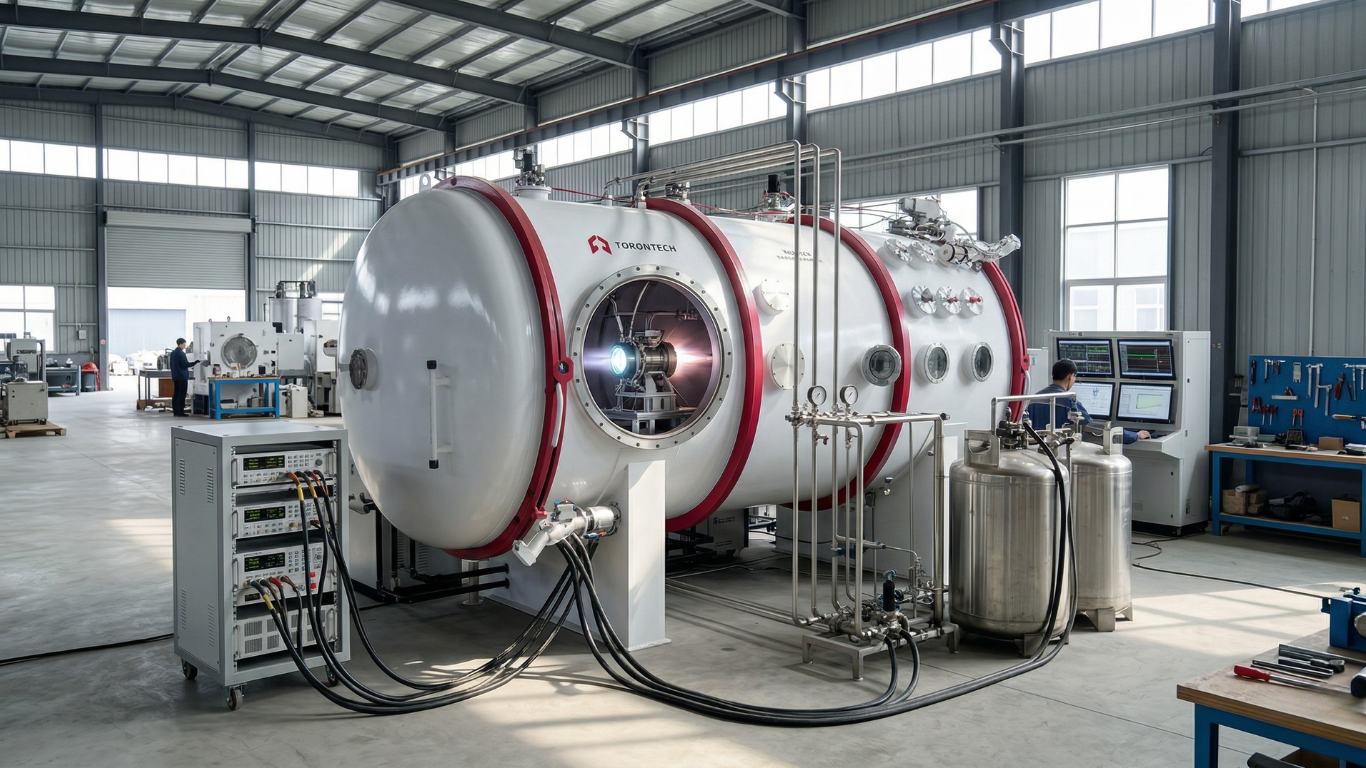
Validating hardware for the rigors of the space environment is a multi-staged journey that begins long before a launch vehicle leaves the pad. Thermal Vacuum (TVAC) Test Chambers are the critical platforms used to recreate the two most unforgiving conditions of low-earth orbit and beyond: extreme vacuum and radical thermal fluctuations. In these controlled environments, the absence of air means convection is virtually non-existent, leaving radiation and conduction as the primary modes of heat transfer.
The central challenge for many aerospace teams is that the requirements for validation evolve significantly as a project moves from individual components to integrated systems. A setup that works perfectly for a small sensor subassembly often fails to meet the instrumentation density, thermal boundary stability, or contamination control needs of a complete satellite. This guide explores the practical path of transitioning from compact unit-level workflows to full-scale Space Simulation Systems. To see how these systems scale across different program stages, you can explore Thermal Vacuum (TVAC) Test Chambers from Torontech and evaluate configurations designed for everything from small-cube tests to full-satellite missions.
What Thermal Vacuum (TVAC) Testing Is Actually Verifying
The goal of a TVAC program is to identify “vacuum-dependent failure modes” that simply do not appear in standard atmospheric testing. When you place a test article inside Thermal Vacuum (TVAC) Test Chambers, you are verifying more than just structural survival; you are validating complex interactions:
- Temperature-Driven Drift: Ensuring that sensitive electronics and oscillators maintain timing and signal integrity across the full thermal range.
- Thermal Interface Integrity: Confirming that conductive paths between components and heat sinks perform as designed in the absence of air.
- Outgassing and Contamination: Identifying materials that might release volatile compounds in a vacuum, which can then condense on sensitive optics or solar arrays.
- Thermal Balance: Reaching an equilibrium where the heat generated by internal electronics is perfectly balanced by the radiation to the chamber’s cold shrouds.
- Cycling Fatigue: Subjecting the hardware to repeated “soak” periods at high and low extremes to check for solder joint failures or material delamination.
By simulating these conditions early and often, teams can catch integration errors at the unit level before they become mission-ending anomalies at the system level.
The Scale-Up Path: From Unit-Level to Full-Satellite Programs
As a satellite program matures, the TVAC Chamber requirements grow in both physical size and technical complexity. This progression typically follows three distinct phases.
Phase 1: Unit-Level Validation
At this stage, the focus is on individual electronics modules, control units, or sensor subassemblies. The priorities are setup efficiency and high throughput. Compact systems, such as the ToronTVAC™ 800 or 1000, are ideal here. They offer fast pump-down times and repeatable cold plate workflows, allowing engineers to verify component-level designs quickly.
Phase 2: Component and Subsystem Validation
As modules are integrated into larger subsystems—such as an entire communications suite or a power distribution assembly—the focus shifts. The chamber envelope must grow to accommodate not just the hardware, but also more complex fixturing and a higher density of instrumentation. Thermal Vacuum (TVAC) work at this stage becomes more involved, often requiring more sophisticated thermal interface control to simulate how the subsystem will eventually mount to the satellite bus. Mid-range systems like the ToronTVAC™ 1200 and 1500 series are designed specifically for this middle tier.
Phase 3: Large Assemblies and Full-Satellite Validation
The final transition to full-satellite validation is the most demanding. Priorities expand to include stable long-term setpoints, documented pressure control sequences, and advanced contamination control (such as TQCM monitoring). These programs require high-channel-count data acquisition (DAQ) systems to monitor hundreds of temperature points simultaneously. Large-scale Space Simulation Systems, such as the ToronTVAC™ 2400 and 3600, provide the necessary volume for complex cable routing and the thermal hardware needed for full-satellite mission simulation.
What Changes as the Test Article Gets Bigger
Transitioning to a larger TVAC Chamber is not merely about “buying a bigger box.” It represents a fundamental shift in the test workflow:
- Chamber Envelope Requirements: You must account for “stay-out” zones, shroud clearances, and the space required for internal handling equipment.
- Fixture Complexity: Larger articles require robust mounting structures that must not interfere with the thermal signatures being measured.
- Sensor Count: A unit-level test might use 10 thermocouples; a full satellite may require 200 or more, necessitating massive feedthrough flanges.
- Contamination Control: Larger surface areas increase the risk of outgassing, requiring specialized cryo-traps and cleanroom-compatible chamber interfaces.
- Pump-Down Stability: Maintaining a stable vacuum over weeks of testing requires more redundant and high-capacity pumping strings.
TVAC Chamber Selection Factors That Matter at Every Program Stage
Regardless of scale, certain selection factors remain constant but grow in importance as the program progresses:
- Pressure Targets: Matched to the outgassing characteristics and high-voltage (corona) sensitivity of the hardware.
- Thermal Range and Uniformity: Ensuring the shrouds provide a consistent radiative environment without “hot spots.”
- Ramp Rates: The ability to transition between thermal extremes quickly enough to meet schedule but slowly enough to avoid damaging the hardware.
- DAQ and Control: The software must handle increased complexity, providing automated safety interlocks and real-time data visualization for the entire engineering team.
Transition Checklist: When It’s Time to Move Beyond a Unit-Level TVAC Chamber
Use this checklist to identify when your program has outgrown its current Space Simulation Systems:
- The test article no longer fits with at least 15-20% clearance for fixtures and routing.
- You are reaching the limit of available feedthrough ports for sensors or power cables.
- Thermal balance work requires more complex radiative boundaries than a simple cold plate can provide.
- Your project now involves optics or high-sensitivity sensors that require active contamination monitoring.
- You need to validate integrated subsystems where the interaction between components is the primary test goal.
- Customer or agency requirements now mandate more formal, automated documentation of every pressure and temperature transition.
Why Repeatability Matters More During Scale-Up
The cost of an inconsistent test run increases exponentially with the size of the test article. In a full-satellite program, the setup time alone can take weeks. If the TVAC system fails to provide a repeatable pump-down or stable thermal boundaries, the impact on the launch schedule can be catastrophic.
Transitioning to professional-grade Space Simulation Systems is essentially about controlling this complexity. By ensuring that the vacuum behavior is identical across every run, engineers can isolate hardware performance from chamber artifacts, leading to faster, more confident decision-making.
How Propulsion and Micro-Force Work Fit Into the Broader Validation Program
While thermal and vacuum testing are the core of satellite validation, some programs require adjacent specialized environments. For example, some aerospace teams pair their TVAC campaign with electric propulsion testing. This involves measuring Hall thruster performance or conducting micro-thrust and actuator characterization under vacuum. While these are often separate systems—designed to handle the unique gas loads of thruster plumes—they should be planned in parallel with the broader Thermal Vacuum (TVAC) strategy to ensure all mission-critical components are validated under representative conditions.
Common Scale-Up Mistakes
- Volume Miscalculation: Buying a chamber that fits the satellite but leaves no room for the technicians to reach the connectors or for the thermal shrouds to breathe.
- Underestimating Routing: Forgetting that 100 extra cables require significant flange space and can act as heat “leaks” if not properly managed.
- Delaying Contamination Planning: Assuming you can “clean the chamber later” rather than building a contamination-controlled workflow from the start.
- Ignoring Data Density: Using a DAQ system designed for unit testing that becomes sluggish or unreliable when managing hundreds of high-speed channels.
- Focusing Only on Cooling: Neglecting the “bake-out” or high-temperature capabilities needed for material outgassing before the actual mission simulation begins.
Why Buyers Compare Space Simulation Systems on Torontech
Torontech provides a staged approach to aerospace validation, offering a range of Thermal Vacuum (TVAC) Test Chambers that scale alongside the program. By categorizing systems from unit-level platforms to full-satellite simulators, they help engineering teams choose a system based on their current integration stage while keeping an eye on future growth. This alignment with real-world aerospace workflows ensures that the system provides the required pressure, thermal stability, and data acquisition precision at every milestone.
Explore Torontech TVAC systems and request a quote for the configuration that matches your transition from unit-level testing to full-satellite validation.
Final Thought
Scaling from component qualification to full-satellite validation is one of the most challenging transitions in aerospace engineering. It requires a shift in thinking from “simple testing” to “complex system simulation.” By selecting Thermal Vacuum (TVAC) Test Chambers that offer the right balance of volume, instrumentation density, and thermal control, you can ensure that your hardware is ready for the vacuum of space. Define your next integrated milestone today, and choose a Space Simulation System that will grow with your mission.
