
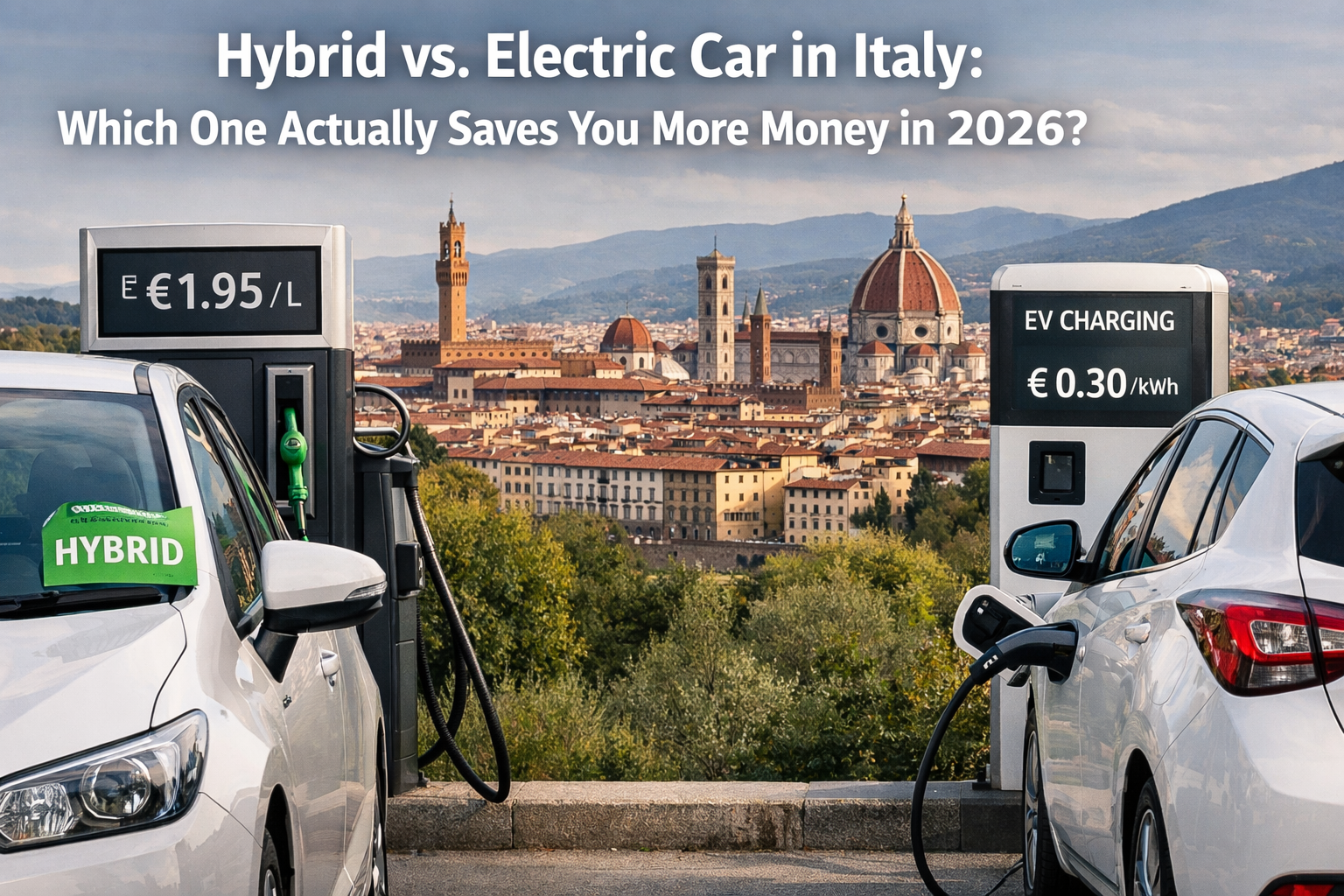
Italy is changing fast. The government doubled taxes on petrol and diesel company cars in 2025. The Ecobonus keeps putting cash back in buyers’ pockets. And millions of Italian drivers are now staring at the same question: hybrid or electric?
This guide cuts through the noise. You will find real numbers on the bollo auto, Ecobonus incentives, fuel costs, insurance, maintenance, and hidden perks like ZTL access. Read it once and you will know exactly which car wins for your situation.
What Are We Actually Comparing?
Before diving into taxes and costs, let us be clear about the vehicle types we compare:
- BEV (Battery Electric Vehicle): Runs 100% on electricity. No combustion engine. Examples: Fiat 500e, Tesla Model 3, BYD Atto 3.
- HEV (Full Hybrid Electric Vehicle): Combines a petrol or diesel engine with an electric motor. The battery charges itself through regenerative braking. You never plug it in. Examples: Toyota Yaris Hybrid, Toyota Corolla Hybrid.
- PHEV (Plug-in Hybrid Electric Vehicle): Has a larger battery you can charge from an outlet. Runs on electricity for short distances, then switches to the combustion engine. Examples: Jeep Compass PHEV, Volkswagen Golf GTE, BMW 330e.
- MHEV (Mild Hybrid Electric Vehicle): Has a small electric assist motor but cannot run on electricity alone. Saves small amounts of fuel. Treated more like a regular petrol car for tax purposes.
For most of this guide, the comparison is BEV vs HEV/PHEV because those are the real choices Italian buyers face.
The Bollo Auto: Where Electric Cars Win Big
The bollo auto is Italy’s annual vehicle ownership tax. It is a regional tax, calculated based on the car’s power in kilowatts (kW) and its Euro emission class (Euro 0 to Euro 6).
How the Bollo Is Calculated
For a standard petrol or diesel car with Euro 4, 5, or 6 classification:
- €2.58 per kW for the first 100 kW
- €3.87 per kW for each kW above 100
So a 100 kW Euro 6 petrol car pays roughly €258 per year. A 130 kW SUV pays around €364 per year.
How Hybrid Cars Are Taxed
For full hybrids (HEV), the bollo is calculated only on the power of the internal combustion engine, excluding the electric motor. This is a key advantage.
Take the Toyota Yaris Hybrid: its combined power is around 85 kW, but the petrol engine alone produces about 68 kW. You pay bollo only on those 68 kW, not the full system power. That saves you a meaningful chunk each year compared to a pure petrol car of similar performance.
PHEVs follow similar rules in most regions, with their combustion engine kW used as the base for calculation.
How Electric Cars Are Taxed
For BEVs, the bollo calculation uses the maximum continuous power output as defined by ECE R85 regulation, which is typically lower than the peak power you see in marketing materials. This already reduces the taxable base.
But the bigger benefit is the exemption:
All electric cars in Italy are fully exempt from the bollo auto for the first 5 years from the date of first registration. This applies in every single Italian region, with no exceptions. To get the exact amount you owe (or to confirm your exemption), use the official calculator at calcolobollo-auto.it by entering your license plate number.
After the 5-year exemption, most regions charge only 25% of the standard rate. That means a BEV that would normally owe €300 per year pays just €75.
Regional Differences: Where You Register Matters
Italy’s regional autonomy creates real differences. Here is a breakdown of the most important ones:
| Region | BEV Bollo | Hybrid Bollo |
| Lombardia | Permanent exemption | 50% discount for 5 years (with scrapping) |
| Piemonte | Permanent exemption | Full exemption for some years |
| Valle d’Aosta | Exempt for 8 years | Reduced rates |
| Emilia-Romagna | Exempt for 5 years | Partial discounts |
| Toscana | Exempt for 5 years, then 25% | Standard rates, few discounts |
| Friuli-Venezia Giulia | National rules apply | No special discounts |
| Lazio, Calabria, Sardegna | National rules apply | Standard national rates |
Key takeaway: If you live in Lombardia or Piemonte and buy an electric car, you never pay the bollo. That is a saving of €150 to €400 every single year, for life. Hybrid drivers in most regions pay the standard rate after the initial exemption period ends.
The Ecobonus 2025-2026: Free Money on the Purchase Price
Italy’s Ecobonus is a national purchase incentive funded through the PNRR (Piano Nazionale di Ripresa e Resilienza). It dramatically changes the true cost of buying an electric car.
BEV Incentives (2025-2026)
The 2025 Ecobonus offers:
- Up to €6,000 for a new BEV without scrapping an old vehicle
- Up to €11,000 for a new BEV when scrapping a Euro 0-5 vehicle
- If your ISEE income is below €30,000, the incentive increases by 25%, reaching up to €13,750 when scrapping a Euro 0-2 car
- The electric car must cost no more than €35,000 excluding VAT (roughly €42,700 with VAT)
- You must apply through the Sogei platform using your SPID or Carta d’Identità Elettronica
- You must live in a municipality classified as a FUA (Functional Urban Area) by ISTAT
PHEV Incentives (2025-2026)
The scheme has been refinanced for 2026, but the current round targets BEVs exclusively. In previous rounds, PHEVs received up to €8,000 with scrapping and €5,000 without. Check the MASE (Ministero dell’Ambiente e della Sicurezza Energetica) website for the latest PHEV eligibility.
Regional Stackable Incentives
On top of the national Ecobonus, some regions offer extra money:
- Lombardia: Up to €4,000 extra per BEV for local small and medium businesses, when scrapping an older vehicle
- Bolzano/South Tyrol: €2,000 for private buyers of BEVs, often doubled to €4,000 through utility company grants
- Piemonte, Veneto, Trento: Periodic scrapping bonuses when local air quality funds are available
Provincial Registration Fee (IPT)
Italy has no CO2-based registration tax like some other European countries. But there is a provincial registration fee called IPT (Imposta Provinciale di Trascrizione). Many provinces fully waive this fee for electric vehicles, adding another small but real saving at the point of purchase.
Fuel and Energy Costs: The Real Daily Saving
This is where electric cars pull far ahead for high-mileage drivers.
What Italian Drivers Pay per 100 km
- Petrol: At around €1.70-1.85 per liter, and assuming 6-7 liters per 100 km for a small-to-medium car, you pay €10 to €13 per 100 km
- Diesel: Slightly better fuel economy but similar price. Around €8 to €11 per 100 km
- Full Hybrid (HEV): Hybrids shine in city traffic. Real-world consumption drops to 4-5 liters per 100 km. Cost: €7 to €9 per 100 km
- PHEV (charged daily): If you charge every night and your daily commute fits within the electric range (typically 40-70 km), your real fuel cost can drop below €3 per 100 km. If you never charge it, you pay the same as a petrol car, sometimes more
- BEV (home charging): Italian residential electricity costs roughly €0.25-0.30 per kWh. A car consuming 18 kWh per 100 km costs €4.50 to €5.40 per 100 km at home. That is a 50-60% saving over petrol
The Public Charging Problem
Home charging is the key variable. If you charge at a fast public charger (DC), costs rise sharply to €0.50-0.80 per kWh in Italy, pushing per-100-km costs up to €9 to €14. This wipes out the fuel saving entirely.
Drivers without home charging access (apartment dwellers without a garage, for example) need to do hard math before buying a BEV. A PHEV or full hybrid often makes more financial sense if public charging is your only option.
Italy’s government is deploying €740 million through the PNRR to install around 21,000 public chargers by 2025. The network is growing, but it remains uneven outside major cities and motorway corridors.
Taxes on Company Cars: A Game-Changer Since 2025
If you use a company car in Italy, the Legge di Bilancio 2025 (Budget Law 2025) completely changed the math.
Fringe Benefit Tax Rates from January 2025
The fringe benefit is the taxable value assigned to a company car that an employee also uses for personal trips. From January 1, 2025:
| Vehicle Type | Fringe Benefit Rate |
| BEV (Battery Electric) | 10% of the ACI reference value |
| PHEV (Plug-in Hybrid) | 20% of the ACI reference value |
| HEV, Petrol, Diesel | 50% of the ACI reference value |
What this means in practice: A company car with an ACI reference value of €3,000 per year creates:
- €300 taxable income for an EV driver
- €600 taxable income for a PHEV driver
- €1,500 taxable income for a petrol or diesel driver
At a marginal tax rate of 35%, the EV driver saves €420 per year in personal income tax compared to the petrol driver. Over a 4-year leasing contract, that is a €1,680 personal tax saving just on the fringe benefit, with nothing else changing.
This makes electric vehicles dramatically cheaper as company cars. Italian companies have already started restructuring their fleets to take advantage of these rules.
Maintenance Costs: Electric Wins Long-Term
Over 100,000 km of ownership:
- Petrol/Diesel car: €4,000 to €6,000 in maintenance (oil changes, timing belts, exhaust systems, spark plugs, brake pads)
- Electric car: €2,000 to €3,500 (no oil changes, fewer brake jobs thanks to regenerative braking, no exhaust system, no timing belt)
Electric cars eliminate:
- Engine oil changes (saving €150-300 per year)
- Spark plugs and ignition systems
- Timing belts and chains
- Exhaust system repairs and catalytic converters
- Most clutch work on automatics
Full hybrids reduce these costs compared to pure petrol cars but do not eliminate them. The combustion engine still needs oil changes and all the related service items. The hybrid battery adds a complexity cost, but HEV batteries are highly reliable in 2026 and rarely need replacement within a normal ownership period.
PHEVs are the most complex option. They carry both a combustion engine (with its full service schedule) and a rechargeable battery system. Owners essentially pay for two powertrains.
Insurance: The Hidden Cost That Catches People Out
Italian car insurance (RC Auto, the mandatory third-party liability coverage) costs vary enormously. Your region of registration is the single biggest factor.
- Campania: €800 to €1,200 per year
- Friuli-Venezia Giulia: €280 to €420 per year
Beyond region, vehicle type matters:
- BEVs can attract 10-30% insurance discounts in Italy because of their safety profiles and lower accident involvement rates at lower speeds. However, comprehensive cover (kasko) for electric cars is often more expensive due to high battery replacement costs
- HEVs and PHEVs generally pay standard rates, sometimes slightly below average because they tend to be newer vehicles with more safety features
- Repair costs for BEVs are rising as specialized labor is still in short supply in many areas. This is pushing comprehensive premiums up
Always get specific quotes for the exact model you plan to buy before making a decision.
ZTL Access: A Real Money Saver in Italian Cities
Italy’s ZTL (Zona a Traffico Limitato) zones are restricted traffic areas in city centers. Entering without permission triggers automatic camera fines of €83 to €350 plus administrative fees.
Electric Cars: Maximum Access
In most Italian cities, fully electric cars get free ZTL access, provided you register your license plate with the local municipality first:
- Milan (Area C): BEVs enter free (registration required). Area B also restricts the most polluting vehicles, with BEVs freely permitted
- Bologna: BEVs have free ZTL access with plate registration
- Florence: Strict ZTL covering the entire historic center. BEVs may enter freely with advance registration
Important Rome update: Rome approved a new rule in early 2026. Starting July 1, 2026, electric cars will need an annual ZTL permit. The permit will cost 50% less than the equivalent petrol/diesel permit. Certain groups (residents, artisans with workshops inside the ZTL, parents accompanying children to schools inside the ZTL) will still receive it for free. This is a meaningful change for Rome BEV owners and removes one of the city’s previous EV advantages.
Hybrid Cars: Limited Access
Standard HEVs and PHEVs do not automatically qualify for free ZTL access in most Italian cities. They follow the same rules as petrol and diesel vehicles. In Florence and parts of Rome, hybrids must observe the same entry restrictions as any other car.
If you drive daily in a city center with ZTL zones, an electric car remains the more convenient choice in 2026 for all cities except Rome (post-July 2026).
Total Cost of Ownership (TCO): Putting the Numbers Together
Let us compare two realistic scenarios for an Italian private buyer in 2026.
Scenario 1: Urban Driver, Milan, 15,000 km per year, 5-Year Ownership
Car A: Toyota Yaris Hybrid 1.5 HEV (85 kW combined, 68 kW combustion)
- Purchase price: ~€26,000
- Ecobonus: Not eligible for BEV incentive
- Bollo (estimated on 68 kW, Euro 6): ~€175/year, exempt in Lombardia permanently for HEV? No: Lombardia exempts HEV for up to 5 years with scrapping, 50% discount otherwise. Assume 50% discount: ~€88/year for 5 years, then full rate
- Fuel (5L/100km at €1.75): ~€1,312/year
- Maintenance: ~€500/year
- Insurance: ~€550/year (Milan average)
- Estimated 5-year running cost: ~€14,250 (excluding purchase)
Car B: Fiat 500e (87 kW BEV)
- Purchase price: ~€29,000
- Ecobonus (with scrapping): up to €11,000 net purchase cost: ~€18,000
- Bollo: €0 for 5 years (full exemption, permanent in Lombardia after that)
- Electricity (home charging at €0.28/kWh, 18kWh/100km): ~€756/year
- Maintenance: ~€280/year
- Insurance: ~€480/year (with 15% BEV discount)
- Estimated 5-year running cost: ~€7,580 (excluding purchase after Ecobonus)
5-year total (purchase + running):
- Yaris Hybrid: €26,000 + €14,250 = €40,250
- Fiat 500e (after Ecobonus): €18,000 + €7,580 = €25,580
The electric car wins by over €14,000 across 5 years for this urban Lombardia driver with home charging access and an old car to scrap.
Scenario 2: Rural Driver, Abruzzo, No Home Charging, 20,000 km per year
Here the picture shifts. The rural driver:
- Has no home charging, relies on public DC chargers at €0.60/kWh
- BEV fuel cost rises to ~€2,160/year vs hybrid’s ~€1,750/year
- No permanent bollo exemption in Abruzzo (national rules apply)
- After year 5, pays 25% of standard bollo on BEV vs reduced rate on hybrid
In this case, the full hybrid or PHEV is more convenient. The lack of cheap charging access eliminates the biggest BEV running cost advantage.
The Superbollo: When High-Power EVs Pay Extra
The superbollo is an additional national tax on vehicles with power above 185 kW (about 251 hp). It applies to all vehicles including electric ones.
The charge is €20 per kW above 185 kW. So a car with 250 kW pays €20 x 65 = €1,300 per year extra, on top of the standard bollo.
This catches some high-performance BEV buyers by surprise. A Porsche Taycan or Tesla Model S may be exempt from the standard bollo during the 5-year exemption period, but the superbollo is still due from day one if the car exceeds 185 kW.
The superbollo decreases as the vehicle ages and disappears after 20 years. From 2026, the superbollo remains a national tax even as the ordinary bollo moves further toward full regional control.
How to Calculate Your Exact Bollo
The fastest way to get the exact amount for your car in your region is to use the official calcolobollo-auto.it tool. Enter your license plate and the system pulls your vehicle’s kW rating, Euro class, and region to give you the precise figure, including whether an exemption applies.
Manual calculation requires knowing:
- Your car’s kW (from the registration document – libretto di circolazione)
- Your vehicle’s Euro class
- Your region of residence
- For hybrids: only the combustion engine kW, not the total system power
- For BEVs: the continuous power per ECE R85, and your registration date to check exemption status
Buying Used: Hybrid or Electric?
The used electric car market in Italy is growing but comes with one critical question: how much battery capacity remains?
Used BEV buying tips:
- Always ask for a battery health report (State of Health / SoH). A healthy battery should show above 80% SoH after 5 years
- Check the first registration date on the libretto di circolazione. You inherit whatever exemption time remains. A BEV first registered in 2022 still has one year of free bollo left in 2026
- Battery replacement costs remain high (€5,000 to €15,000 depending on vehicle), but most batteries last well beyond 150,000 km with normal use
Used hybrid buying tips:
- Hybrid batteries are generally more reliable than people assume. Toyota, Honda, and other long-standing hybrid makers have decades of data showing their packs last 200,000+ km in most cases
- Check whether the vehicle was used mainly in city driving (better for hybrid efficiency) or motorway driving (where hybrids lose their efficiency advantage)
- Used hybrid prices are often more predictable than BEV prices, which can drop sharply when the new model year arrives
Who Should Buy Electric in Italy Right Now?
You are a strong candidate for a BEV if:
- You have home charging access (garage, private parking, wall box)
- Your annual mileage exceeds 12,000 km (the energy cost saving compounds fast)
- You live in Lombardia, Piemonte, or another region with generous or permanent bollo exemptions
- You drive regularly in ZTL city centers (Milan, Bologna, Florence)
- You use the car as a company vehicle and want to maximize the fringe benefit tax advantage
- You can access the Ecobonus and have an old car to scrap
You are a better match for a hybrid (HEV or PHEV) if:
- You do not have reliable home charging
- You regularly drive long distances on motorways where BEV range anxiety is real
- You live in a region with weak or no extra incentives for BEVs after year 5
- Your budget is tight and the post-incentive price of a BEV still exceeds what you can afford
- You need flexible, predictable refueling anywhere in Italy
Environmental Impact: The Full Picture
Electric cars produce zero tailpipe emissions, which directly improves air quality in Italian cities, many of which regularly exceed EU limits for particulate matter (PM2.5) and nitrogen oxides (NOx).
However, lifecycle emissions depend heavily on how Italy generates its electricity. Italy’s grid still relies on natural gas for a significant share of power production. BEVs charged on the Italian grid today produce lower lifecycle CO2 than comparable petrol cars, but the margin is smaller than in countries with more renewable electricity like Norway or France.
As Italy increases its share of solar, wind, and hydroelectric power (all growing under the PNRR energy transition targets), the lifecycle advantage of BEVs will grow further.
Hybrid cars reduce emissions compared to pure combustion vehicles but still burn fossil fuel. They are a genuine improvement, not a fake transition, but they do not solve the urban air quality problem the way BEVs do.
Key Changes to Watch in 2026 and Beyond
- Rome ZTL paid permit for BEVs starts July 1, 2026. A major change for Rome drivers.
- Ecobonus funding ends June 30, 2026 under current PNRR allocation. No confirmed renewal yet.
- Bollo reform 2026: New rules link the payment deadline to the month of registration (not a fixed calendar date) for new registrations from January 2026. Single payment required, no more installments for new cars.
- Possible bollo exemption for incomes below €8,000 is under discussion but not yet confirmed for all regions.
- Superbollo stays national even as ordinary bollo moves toward full regional management.
- Charging infrastructure continues to expand under €740 million in PNRR funding for ~21,000 new public chargers.
Summary: Hybrid vs Electric in Italy 2026
| Factor | Full Hybrid (HEV) | Plug-in Hybrid (PHEV) | Electric (BEV) |
| Purchase price | Lower | Medium | Higher (reduced by Ecobonus) |
| Ecobonus | No | Sometimes | Up to €13,750 |
| Bollo auto | Partial discount (varies by region) | Partial discount (varies by region) | 5-year full exemption, then 25% |
| Bollo in Lombardia/Piemonte | 50% discount for 5 years | Varies | Permanent exemption |
| Fuel cost | Medium-low | Low (if charged daily) | Lowest (home charging) |
| Maintenance cost | Medium | Medium-high | Lowest |
| ZTL access | Standard rules | Standard rules | Free in most cities |
| Company car tax | 50% fringe benefit | 20% fringe benefit | 10% fringe benefit |
| Best for | Rural, motorway, no home charging | Mixed use, home charging available | Urban, home charging, high mileage |
Bottom line: If you live in an Italian city, have home charging, and can access the Ecobonus, a full electric car wins financially in 2026 by a clear margin over 5 years. If you drive mainly on motorways, live in a rural area, or lack reliable home charging, a full or plug-in hybrid remains the smarter, more flexible choice until Italy’s public charging network matures further.
