
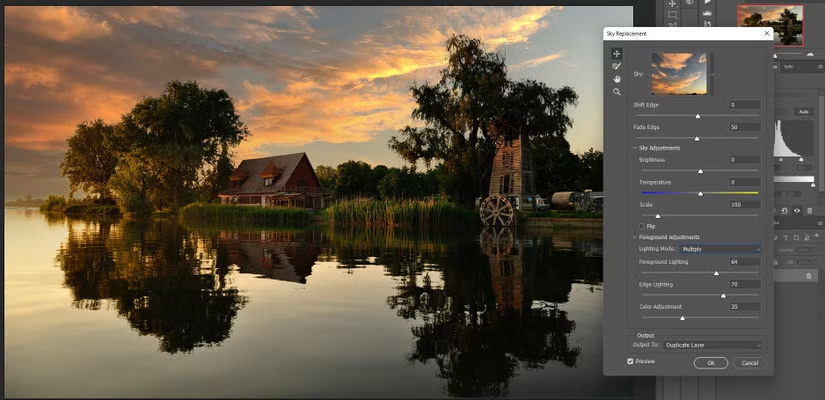
Cover the sky in a lakeside photograph and look just at the water. A silvery surface and a dark shoreline suggest a different afternoon from the one in a blazing sunset. That reflection can help you choose a replacement sky before you spend time masking a single tree.
For a creative landscape, the trick is choosing a sky the existing water could plausibly reflect. That decision matters more than getting a flawless selection around every twig. Start with a modest brief: a cool overcast lake, a lighter patch of cloud above the distant shore, and enough tonal variation to separate the hills from the weather.
Let the shore choose the weather
Read the light on objects that have a clear shape. Look at the underside of a boat, the side of a white building, and the shadow under a bench. Hard, sharply directed shadows give you a likely direction for the sun.
If the shadows are broad and faint, light is arriving from a much larger area of sky. A candidate sky with a small bright sun in one corner promises long shadows the scene may not contain.
Next, find the horizon even if you cannot actually see it. A line of trees growing up a slope is a skyline rather than a level horizon. Cloud scale and perspective should feel consistent with the lake and the camera position.
A towering bank of enormous clouds immediately behind a low ridge can read like a painted theatre backdrop. A subtle band of brighter air toward the distance gives you more room to reconcile sky and shore.
Finally, study the color already in the water. A shallow green lake may retain green near the camera because you can see through it. A shaded bank can hold brown reflections from trunks and reeds. You may only need to alter an open strip of water beyond those colors. That is good news. Every part of the original reflection you keep is one less relationship you have to invent.
Give the sky its own edit
Work from an original-resolution copy and keep the uncropped frame until the edit holds together. The extra area around a composition can reveal the light source or the end of a reflection.
If you’re going to edit a landscape photo with AI, Magnific makes sense for this job because you can annotate the area above the skyline or supply a reference photograph for the cloud treatment. Pick a reference for its lighting and scale, even if another sky looks more dramatic in isolation.
Ask for a broken layer of pale cloud with soft daylight behind it, keeping the treeline, shore, and water in place. Save the result as a separate version. Examine the skyline against the original before moving on. A model can simplify thin branches or move a small mast so slightly that you miss it while admiring the new sky. Toggle between versions while watching one landmark at a time.
The awkward places tend to be little openings inside objects. A gap between two branches may keep a scrap of the old sky. A section of railing may lose its top bar. At ordinary size both appear as pale chips.
When a new generation keeps damaging the same object, preserve that part of the original through a conventional mask and blend the sky around it. For a tiny patch, a simple composite often takes less time than rewriting the entire instruction.
Divide the water by what it reflects
Stand mentally at the edge of the lake and move across the frame. The dark column below a tree belongs to the tree. The slender streak below a light-colored dock piling belongs to the piling. An open band facing distant sky has more freedom to change. Treating everything below the shoreline as one mirror tends to erase the features that tell a viewer where the shore starts.
On still water, check a prominent cloud against the shore. The patch reflected closest to the camera may come from sky outside the top of the frame. Flipping the visible sky can give you a starting point, but look at the water and the camera angle before keeping it.
On choppy water, color distribution and brightness often carry the effect. Small ripples break a cloud into interrupted bands. Look at the size and direction of those ripples in your source. Keep the bright glints that belong to their shape, and let a patch of warm sky register as scattered warm fragments. A crisp reflected cloud pasted over rough water looks like a photograph has been laid on top of the lake.
Make the second pass smaller than you think
Begin with the least invasive change. If the replacement sky is only a little cooler than the original, try a gentle local shift in the open-water area. Preserve the water’s texture, the darker reflections, and areas close to shore. With a soft transition, the perceived color of the scene can come together without generating any new water at all.
When a larger change is necessary, give the water a separate instruction. For example: “Bring a narrow band of pale blue-gray into the open water beyond the moored boat. Retain the existing ripples, the dark reflected hull, and the brown reeds near the camera.” The boat is an excellent landmark because you can compare the hull and its reflection directly between versions. If the hull moves, the edit has expanded beyond its brief.
Pay attention to brightness, especially just under the distant bank. It is easy to make the lower half of the image as luminous as the sky when you are concentrating on hue. Compare the candidate against several parts of the original lake where you understand the light.
Water appearance changes with viewing angle, depth, and surface roughness. There is no percentage by which every reflection should be darkened. The original supplies a better guide than a universal opacity setting.
Three signs that the pieces still disagree
A band of pale fog sits on the skyline. This can be a leftover halo from the original sky. Inspect it at full size where a hill meets a smooth stretch of sky. If the same bright band runs around every tree, repair the edge. Real distant haze should also make sense across the broad face of the hill.
A cloud is sharp in the lake and soft overhead. Inspect nearby reflected objects of comparable size. They tell you how much detail the water can carry. If a boathouse is reduced to broken horizontal marks, the reflected cloud should probably lose some definition too. Reduce its local contrast or return to the original ripples and change their color more gently.
One side of the frame suddenly looks sunny. A golden cloud above a cool, uniformly lit village can introduce an implied light source. Look again at the roofs facing that direction. Rebuilding every roof, tree, and boat is a lot of work for a minor sky improvement. A cooler patch of cloud that suggests distant light may give you the separation you wanted with fewer contradictions.
Shrink the landscape to postcard size. Cover the water, decide what the weather looks like, then uncover it. If the light still feels plausible, save the composite beside the original and mention the sky replacement when you share the picture.