
Injury compensation lawyers gather medical records, witness statements, financial documents, and expert reports to build a complete evidence file for your claim. Without them, insurers can dispute the severity of your condition or question whether the accident caused your injuries in the first place.
Generally, compensation claims rely on proof. For example, a workers’ claim needs workplace incident forms and medical records, while a car accident claim requires police statements and repair invoices. This way, the claims process moves faster when everything is ready upfront.
This article explains the types of evidence commonly required in personal injury claims, how missing records are obtained, and what happens when a file contains gaps. It also outlines how legal professionals, including vbr Lawyers, may assist you with gathering and organising documentation during the claims process.
Let’s get into it.
What Evidence Do You Need for a Compensation Claim?
For a compensation claim, you need medical records, witness statements, incident reports, and financial documents to support your claim.
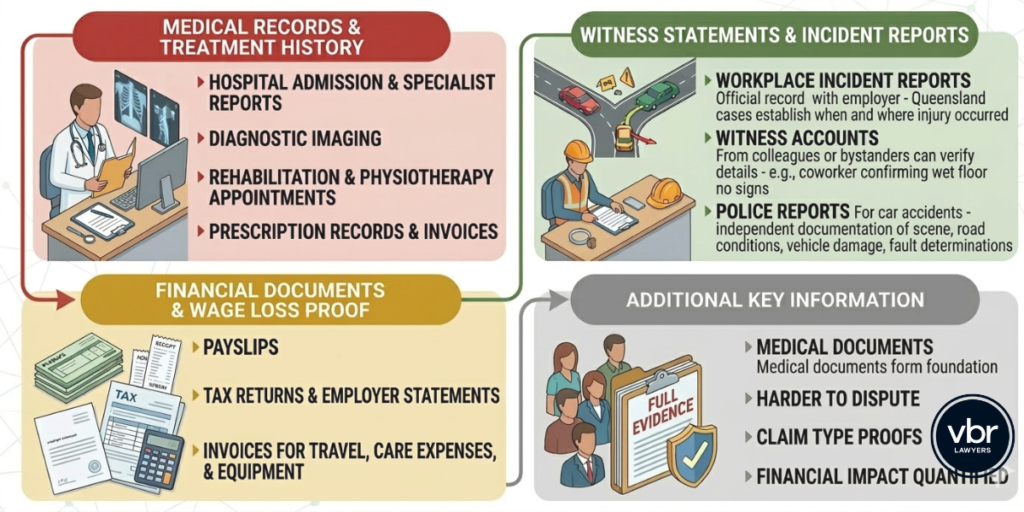
Usually, different claim types require different forms of proof. Yet, one principle stays the same across all personal injury law cases, and that is: the more complete your evidence, the harder it is for an insurer to dispute your version of events.
Now, let’s have a look at the supports that count the most to prove your claim:
Medical Records and Treatment History
Hospital admission records, diagnostic imaging, and specialist reports show the extent of your injuries. These documents often form the medical foundation of any compensation claim.
Besides, rehabilitation appointments, physiotherapy sessions, and specialist consultations all add weight to your claim. In fact, the more medical evidence you have, the clearer the picture of your injury becomes.
That is because prescription records and rehabilitation invoices prove the medical costs directly linked to your injury. Plus, they show how much treatment you have needed since the accident.
Witness Statements and Incident Reports
Workplace incident reports filed with your employer create an official record of what happened. In Queensland workers’ compensation cases, these forms establish when and where the injury occurred.
Also, witness accounts from colleagues or bystanders can verify how the accident happened and who was present. For example, if you slipped on a wet floor at work, a coworker who saw it happen can confirm the hazard was there and that no warning signs were in place. So, their statement adds another layer of proof beyond your own account.
Meanwhile, police reports for car accidents provide independent documentation of the crash scene and initial findings. They note road conditions, vehicle damage, and fault determinations.
Financial Documents and Wage Loss Proof
Payslips before and after the injury show lost wages and reduced working capacity. If you have been unable to work full hours or had to take unpaid leave, these records make the loss visible.
Tax returns and employer statements also help to calculate ongoing financial losses from your inability to work. They also show your earnings history, which determines how much you could have earned if the injury had not happened. As a result, these statements become particularly important in workers’ compensation claims.
Beyond medical bills, invoices for travel, care expenses, and equipment also demonstrate the full financial impact. Each of these expenses forms part of the compensation you may claim.
How Injury Compensation Lawyers Gather Supporting Documentation
Lawyers usually request medical files from hospitals, coordinate with employers for workplace records, and engage independent experts to review technical evidence.
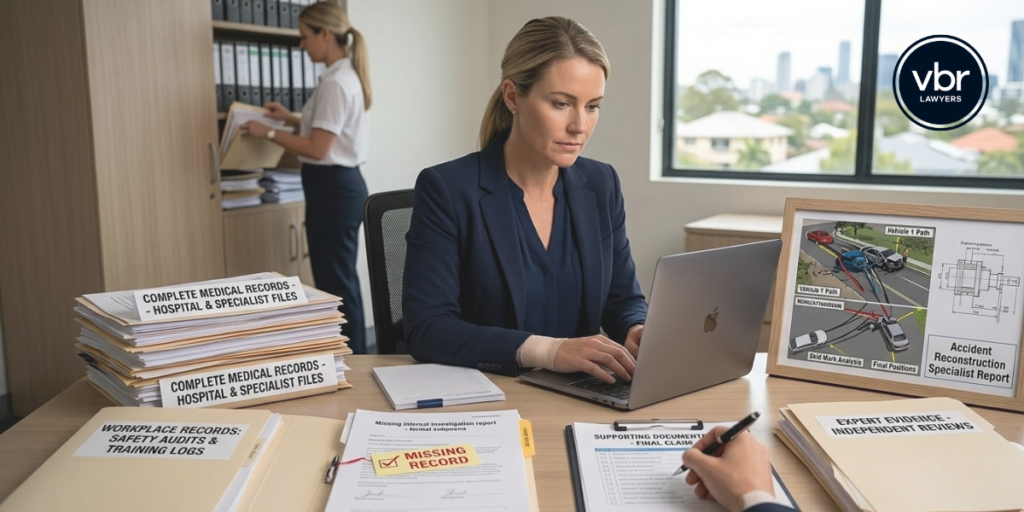
Sometimes, missing records can delay your claim or give the insurer room to question the severity of the injury. In this situation, compensation lawyers request complete medical files directly from hospitals and specialists to close those gaps before they become problems.
They also coordinate with employers to obtain workplace safety audits, training logs, and internal investigation reports. Later, these documents show whether your employer followed proper safety procedures and whether the workplace illness or injury could have been prevented.
However, employers do not always hand over complete records voluntarily, so legal teams use formal requests to get everything on file.
In special cases, lawyers even engage independent experts to review technical evidence like engineering reports or accident reconstructions. For instance, in a car accident case where fault is disputed, an accident reconstruction specialist can analyse vehicle damage, skid marks, and road conditions to determine how the crash happened.
Bottom Line: Expert evidence can support your version of events and settle disputes about responsibility before the claim even reaches court.
Expert Legal Support: Building Your Workers’ Compensation Case
Compensation lawyers understand which types of evidence insurers examine most closely.
After all, workers’ compensation claims in Australia involve strict legal tests and tight deadlines. So, having expert legal support here means working with someone who understands the claims process. Here is how legal teams handle the three most common claim types:
Insurance Company Negotiations and Evidence Review
Compensation lawyers identify missing evidence early and obtain it before insurers request additional documentation. Gaps in the file can give insurers a reason to delay payments.
They also ensure medical reports address the specific legal tests required for workers’ compensation claims in Queensland. However, a medical practitioner’s report must confirm if the injury arose out of, or occurred in the course of, employment. Without that language in the report, the insurer can reject it.
Medical Negligence Claims and Specialist Reports
Medical negligence claims require proof that a medical practitioner provided care below accepted standards and caused harm. The following evidence is commonly used to establish this:
- Independent Review: Medical experts review your treatment to determine if clinical errors caused additional harm or injury.
- Hospital Protocols and Notes: Lawyers obtain hospital records to compare the care provided with accepted medical standards. However, complete files may require multiple requests due to inconsistent record-keeping.
- Causation Links: Specialist reports connect the negligent act to the specific injuries you’ve experienced since.
This level of documentation proves why medical negligence cases often involve complex illness or permanent impairment issues. From there, the focus shifts to proving how the injury affects your life and work.
Car Accident Investigations and Police Records
Lawyers obtain police reports, traffic camera footage, and dashcam videos to reconstruct how the accident happened. In car accident claims where fault is disputed, this evidence determines who pays.
Besides, they also coordinate with accident investigators to analyse vehicle damage, road conditions, and contributing factors. For instance, brake marks and impact points tell a story about speed and fault at the time of the crash.
Beyond these, legal teams gather repair quotes, vehicle assessments, and engineering reports to document damage and liability.
What Happens When Evidence Is Incomplete or Missing?
Incomplete evidence can delay your claim assessment or lead insurers to dispute the severity of your injuries.
In fact, gaps in medical records can lead insurers to question the severity or cause of your injuries. If you saw multiple medical practitioners after the accident but only submitted records from one clinic, the insurer might argue the injury wasn’t serious enough to require ongoing treatment.
Furthermore, they will use missing documentation to reduce the compensation amount or reject the claim entirely.
At times, missing wage documentation makes it harder to verify financial losses during the claim assessment process. Plus, it affects how much you are eligible to receive in workers’ compensation payments or personal injury settlements. That is why you need those records to show the exact amount you’ve lost.
Remember, the longer you wait to gather evidence, the harder it becomes. Delay allows witness memories to fade and physical evidence, including accident scenes, to change or disappear.
Get the Evidence Right From Day One
Strong evidence forms the foundation of every compensation claim. The earlier you start gathering medical records, workplace documents, and witness statements, the better your position when dealing with insurers.
Compensation lawyers can help you to identify gaps in your evidence and obtain the records you need. They know which documents matter most and how to get them quickly. So, if you’re unsure what your claim needs, speaking with a legal professional can save you time and stress.
Contact vbr Lawyers for advice on building your personal injury case. Our team provides support to clients across Queensland and can explain what evidence strengthens your claim.
