
File name: digital-cnc-milling-service-solve-prototyping-delays-cover-image.jpg
Introduction
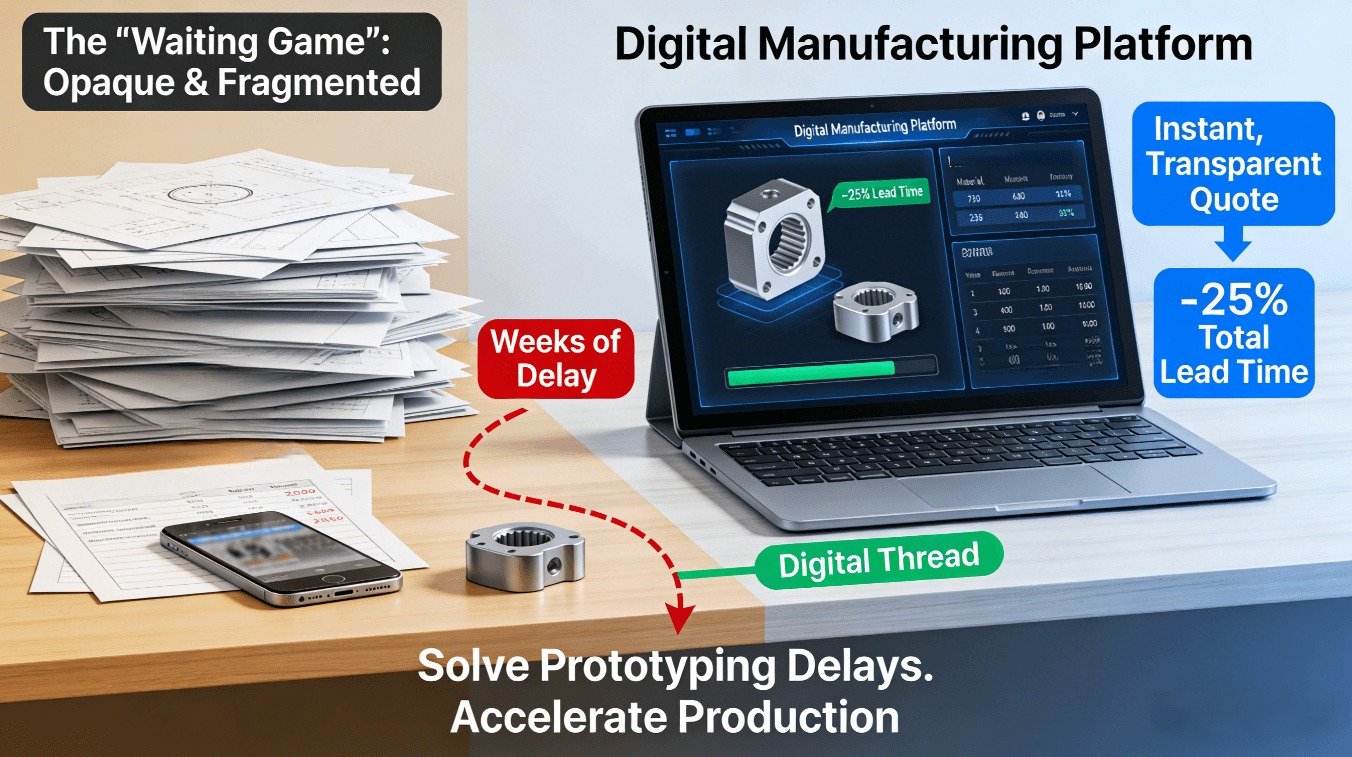
Hardware startups and traditional manufacturers launching new products are often trapped in a protracted cycle of “prototype iteration, pilot production, and market scaling.” Finding a reliable, responsive machining partner becomes a frustrating “waiting game” — weeks spent on inquiries and opaque cost negotiations, coupled with design compromises forced by supplier limitations, ultimately erodes profit margins and causes companies to miss critical market windows. The core issue is a traditional manufacturing procurement process that is highly fragmented, with design, quoting, production, and quality control handled by different teams or companies in non-standardized ways, creating information silos and massive efficiency drains that cannot support rapid iteration or precise cost control.
This article analyzes how digital CNC milling service platforms transform the traditional “black box” into a transparent, predictable “digital thread” through an integrated workflow. From instant design analysis and transparent quoting to traceable production and seamless quality data delivery, this model systematically eliminates uncertainty, compressing the total product development cycle by up to 25%. Let’s explore the specific bottlenecks of traditional manufacturing that this digital transformation breaks.
Where Does the “Waiting Game” in Traditional Manufacturing Really Cost You?
This section quantifies the efficiency bottlenecks in traditional manufacturing, deconstructing the non-value-added time from “sending drawings” to “parts in hand” to highlight the hidden costs of delays and fragmented communication.
1. Mapping the Inefficiency: The Hidden Timeline Tax
The traditional process is riddled with delays. After sending out RFQs, days are lost to supplier screening. This is followed by a back-and-forth clarification loop to resolve ambiguities in the drawings or specifications. Then comes a multi-round price negotiation that can stretch for weeks. Finally, the actual production of the first article begins, with its own inherent lead time. Cumulatively, this front-end administrative and communication burden can add 2-4 weeks before any metal is cut, representing pure timeline tax.
2. The Real Cost: More Than Just Time
The cost of this waiting game extends far beyond calendar days. It represents lost opportunity cost — the revenue forfeited by a delayed product launch. It increases market risk, as competitors may seize the window. It also forces teams into suboptimal, rushed decisions later in the cycle to “catch up,” potentially compromising quality. This mode of operation is antithetical to the agility required in modern product development. As frameworks like the APICS SCOR model emphasize, eliminating non-value-added steps is fundamental to enhancing supply chain responsiveness and reliability.
3. The Digital Platform as an Efficiency Decompressor
A digital manufacturing platform acts as a systemic efficiency decompressor. It compresses the fragmented, sequential steps of the traditional process into a parallel, automated workflow. Supplier discovery, quoting, and order placement happen in a unified digital environment, collapsing weeks of manual effort into hours or even minutes. To understand how a modern digital platform reconstructs the entire manufacturing workflow, this guide on CNC milling services provides a complete perspective from concept to practice.
How Does an “Instant Quote” System Work, and Is It Accurate Enough for Serious Projects?
This section demystifies the technology behind instant quoting engines, explaining that they are sophisticated systems for automated manufacturability and cost analysis, not simple estimators, and that their accuracy is derived from vast historical data.
1. Beyond a Simple Calculator: The Engine of Automated Analysis
An instant quote is not a guess. It is the output of a sophisticated system that performs automated design analysis the moment a file is uploaded. The system’s algorithms perform intelligent geometry feature recognition, identifying holes, pockets, threads, and complex surfaces. It assesses the part’s overall geometric complexity and critical dimensions, translating the CAD model into a language of manufacturable features.
2. Leveraging the Cloud-Based Manufacturing Knowledge Graph
The system then cross-references this analysis against a vast, cloud-based manufacturing knowledge database. This database contains historical data on material costs, optimized machining strategies for thousands of part types, and verified cycle time estimates for different operations. It matches the part’s features and selected material against this knowledge to generate a process plan and a real-time cost calculation that includes material, machine time, and standard post-processing.
3. The Source of Accuracy: Data-Driven Learning
The accuracy of a robust instant quote engine stems from machine learning on project data. The more projects the system processes, the more refined its predictions for machining time and cost become. For standard components, it can be extremely accurate, providing a reliable basis for preliminary budgeting and vendor comparison. It transforms the online CNC milling quote from a weeks-long inquiry into a minutes-long, data-informed starting point for serious project planning.
Can You Really Go from Prototype to Production Without Changing Suppliers?
This section argues for the strategic value of supplier continuity from prototype to production, contrasting the hidden costs and risks of switching partners with the seamless scalability offered by a capable digital platform.
- The Hidden Cost of Supplier Churn: Changing suppliers between prototype and production stages incurs significant, often overlooked costs. It requires re-qualifying the new vendor, which may involve audits and trial orders. There is a re-learning curve as the new supplier must understand the design intent and history. Most critically, it introduces risk of inconsistent standards — slight differences in process, tooling, or inspection philosophy that can lead to part variations, failed qualifications, and delays.
- The Power of a Unified Digital Thread: A digital platform that supports both prototyping and production maintains a unified digital thread. The same 3D CAD model, manufacturing process parameters, and quality standards are used throughout. The data and learnings from the prototyping phase — what worked, what was adjusted — are seamlessly carried forward. This continuity ensures that the prototype provides valid, actionable data for production qualification, enabling a true “soft landing” into volume manufacturing without re-validation shocks.
- The Foundation: Engineering and System Capability: Achieving this seamless continuity is not just a software feature; it requires deep engineering and system capabilities on the manufacturing side. The platform must be backed by a partner with a scalable production infrastructure and a unified quality management system (like ISO 9001) that applies equally to one-off prototypes and thousand-part runs. Therefore, ensuring excellence from the first prototype to the ten-thousandth unit ultimately depends on partnering with a customized precision milling expert with a solid foundation in both engineering and systems.
What Does “Precision” Mean for Medical or Aerospace Parts Beyond the Micrometer?
This section expands the definition of “precision” for highly regulated industries, focusing on the comprehensive systems of traceability, documentation, and advanced verification that are as critical as dimensional accuracy.
1. Full Material and Process Traceability
In sectors like medical devices and aerospace, precision is a traceable history. It means every component can be linked back to its specific raw material heat or lot number, with accompanying mill certificates. The entire manufacturing journey — every machine used, every operator, every inspection result — is meticulously documented. This level of bi-directional traceability is non-negotiable for root cause analysis and is a core requirement of standards like ISO 13485 for medical devices.
2. Comprehensive Documentation and Advanced Metrology
Precision is also proven through comprehensive documentation. A “precise” part comes with a complete data package: a First Article Inspection Report (FAIR) with full CMM data, material certifications, and process travel documents. For critical components, verification may extend to non-destructive testing (NDT) like X-ray or CT scanning to validate internal integrity. The digital platform transforms these compliance deliverables from a burdensome overhead into a standardized, automatically compiled data packet.
3. A Culture of Preventive Quality
Ultimately, for these industries, precision is embedded in a culture of preventive quality, not just final inspection. It’s a system designed to prevent errors through controlled processes, regular equipment calibration, and validated procedures. A digital platform that enforces standardized workflows and captures data at every step is the technological embodiment of this culture, ensuring that “precision” is a guaranteed output of the system, not a hoped-for outcome.
How to Vet a Digital Manufacturing Partner: A Checklist Beyond the Website
This final section provides a practical, in-depth evaluation checklist for selecting a digital manufacturing partner, focusing on engineering collaboration, data transparency, supply chain robustness, and security.
1. Assessing Engineering Collaboration and Value-Add
Look beyond the online portal’s user interface. During the quoting process, does the partner provide substantive Design for Manufacturability (DFM) feedback? Do they explain whya change is suggested and how it impacts cost or lead time? A true partner acts as an extension of your engineering team, offering insights to optimize the design for performance and manufacturability, not just providing a price.
2. Demanding Data Transparency and Evidence
Anyone can claim high quality. The proof is in the data. Does the partner proactively provide detailed inspection reports (like CMM color maps or PDFs with measured values) as a standard deliverable? Is their quality system certified (e.g., ISO 9001, IATF 16949) and do they explain how it impacts your order? Certifications like IATF 16949 represent a preventive quality culture focused on process control, which is crucial for long-term, reliable partnerships in demanding sectors like automotive.
3. Evaluating Operational and Security Integrity
Probe their operational resilience. How do they manage raw material supply and production scheduling to handle demand spikes or shortages? Equally critical is intellectual property (IP) protection. Before uploading files, ensure a robust Non-Disclosure Agreement (NDA) is in place. Inquire about their data security protocols: encrypted file transfer, internal access controls, and data retention policies. Their answers should demonstrate a mature, professional approach to operational and information risk management.
Conclusion
In today’s fiercely competitive hardware innovation landscape, manufacturing agility and reliability have become a core strategic advantage, not a back-office function. By embracing digital CNC milling services that integrate advanced technology with transparent processes, companies can transform their supply chain from a consumer of time and cost into an enabler of speed, quality, and innovation. This is more than an upgrade in procurement; it is the modernization of product development strategy itself.
FAQs
Q: How accurate are online quotes compared to traditional manual quoting?
A: For well-defined 3D models, online quotes from established platforms are highly accurate, often within 5-10% of the final cost, thanks to algorithms trained on thousands of past projects. They excel at standard geometries. For highly complex or novel designs, the online quote provides a solid baseline, with human engineers reviewing and fine-tuning for ultimate precision. The speed advantage is immense.
Q: What file format should I use to get the best and fastest quote?
A: For the most accurate and automated analysis, upload 3D CAD files in STEP or IGES format. These formats preserve precise geometric data. 2D drawings (PDF/DWG) and mesh files (STL) are also accepted, but a 3D model enables comprehensive DFM feedback and minimizes back-and-forth clarification.
Q: What is a realistic lead time for a functional prototype via an online service?
A: For machined metal or plastic prototypes, lead times can be as fast as 1-3 business days for simple parts, and 5-7 business days for more complex ones. The key advantage of online services is the near-instant quoting and order placement, which eliminates the 1-2 week front-end delay typical of traditional sourcing.
Q: How is quality controlled and assured when I can’t visit the factory?
A: Quality is system-driven. Reputable online services are backed by factories with certifications like ISO 9001, which mandate documented processes. You receive digital inspection reports (with photos and CMM data) for your parts. The transparency and structure of the online process itself are indicators of a disciplined, quality-focused operation.
Q: How do you protect my design IP when I upload files?
A: Protection starts with a legally binding Non-Disclosure Agreement (NDA). Files are transferred via encrypted, secure portals. Internal access is strictly controlled on a need-to-know basis. Reputable providers will have clear data retention and destruction policies. You can request a summary of their security protocols before engagement.
Author Bio
This article is based on cutting-edge practices in digital precision manufacturing. By integrating an online platform with advanced physical manufacturing capabilities, LS Manufacturing provides global innovators with an end-to-end solution — from instant, transparent quoting to reliable production delivery — with quality assured by certified management systems including ISO 9001 and IATF 16949. Upload your 3D design file to experience a free manufacturability analysis and a transparent, instant quote within 24 hours, and begin your efficient product development journey.
