
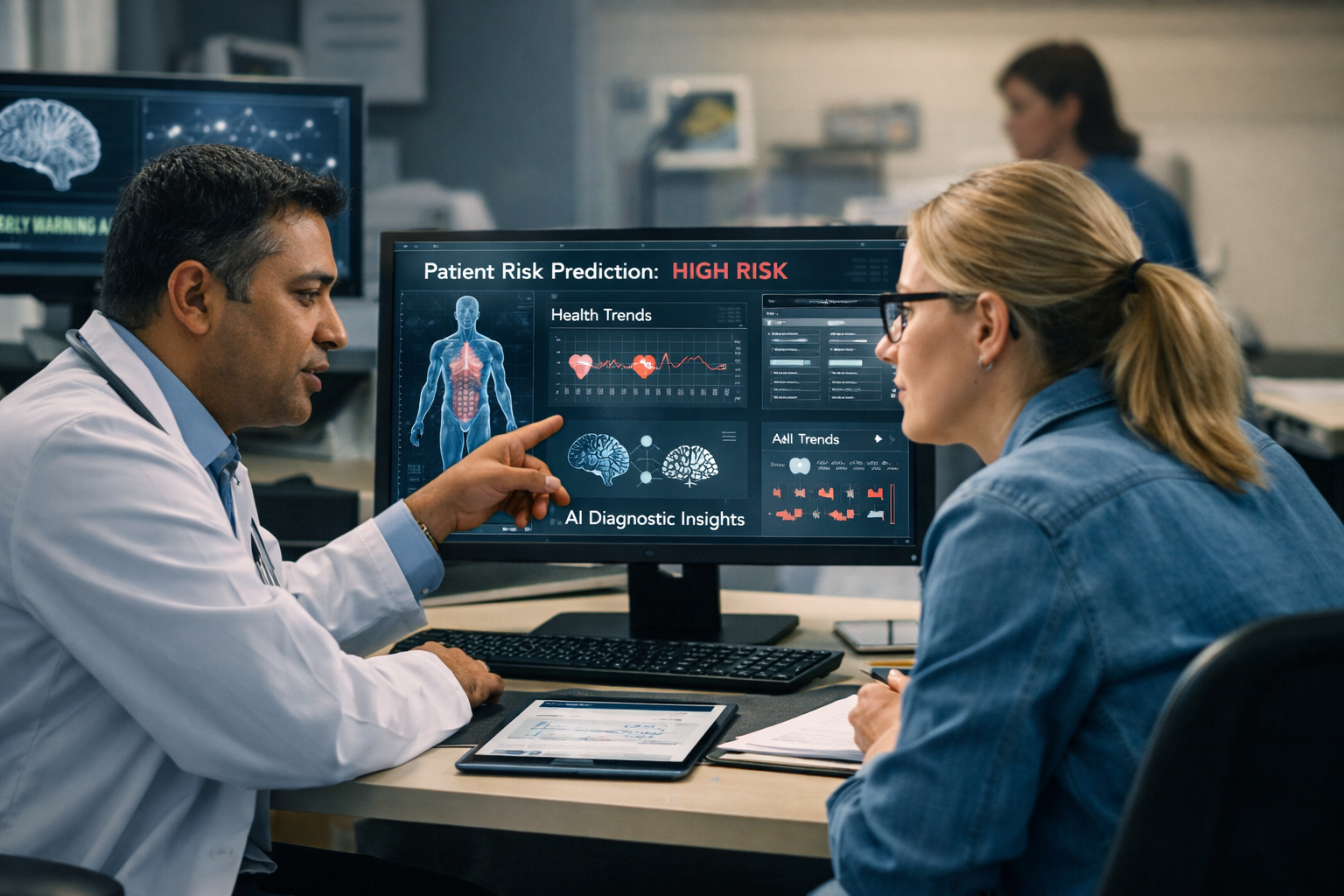
In the fast-paced world of modern medicine, predicting patient outcomes before they spiral isn’t just a sci-fi dream; it’s becoming an everyday reality. Thanks to AI’s seamless integration into healthcare software development, doctors can now spot risks early, personalize treatments, and save lives with unprecedented precision. Imagine a system that flags a heart attack days in advance or predicts sepsis in an ICU patient hours before symptoms appear. This is predictive patient care, and AI is the engine driving it.
At its core, predictive patient care uses machine learning algorithms to analyze vast datasets everything from electronic health records (EHRs) to wearable device data and forecast health events. But building these tools requires sophisticated healthcare software development that blends AI with clinical workflows. Developers aren’t just coding apps; they’re crafting intelligent systems that learn from real-world data, adapt to new patterns, and integrate with legacy hospital tech. This shift is transforming healthcare from reactive to proactive, reducing costs and improving outcomes.
The AI Toolbox in Healthcare Software
AI powers predictive care through several key technologies. Machine learning models, like random forests and neural networks, sift through petabytes of patient data to identify subtle patterns humans might miss. For instance, natural language processing (NLP) extracts insights from unstructured doctor notes, while computer vision analyzes medical images for early tumor detection.
In healthcare app development services, these tools shine in mobile platforms that deliver predictions on-the-go. A healthcare mobile app development company might build an app for chronic disease management, where AI algorithms process glucose readings from a diabetic patient’s smartwatch. The app doesn’t just log data it predicts hypoglycemic episodes and alerts caregivers, preventing emergencies.
Take sepsis prediction as a prime example. Traditional monitoring waits for vital signs to worsen, but AI models trained on historical ICU data can predict onset with 85-90% accuracy up to 48 hours early. Software developers embed these models into dashboards that integrate with hospital bedsides, giving nurses actionable alerts. This isn’t theoretical; hospitals using such systems have cut mortality rates by 20%.
Seamless Integration: Bridging AI with Existing Systems
One of the biggest hurdles in healthcare software development is compatibility. Most hospitals run on established EHR platforms, so AI predictions must flow into these systems effortlessly. Enter Epic integration and epic systems integration, which allow AI-driven apps to pull real-time data from Epic’s vast ecosystem.
Epic EHR integration is a game-changer here. Developers use FHIR APIs to connect predictive AI models directly to Epic records, enabling seamless data exchange. For example, an AI tool analyzing a patient’s Epic chart might predict readmission risks post-surgery. The prediction pops up as a flagged note in the clinician’s Epic dashboard, complete with confidence scores and recommended interventions. This reduces manual data entry errors and speeds up decision-making.
Beyond Epic, AI enhances specialized tools like clinical trial management software. In trials for new drugs, ctms software (or clinical trial management system) leverages AI to predict patient dropout risks by analyzing demographics, adherence patterns, and social determinants of health. A clinical trial management system powered by predictive AI can optimize recruitment, matching participants to trials with 30% higher retention rates. Developers at a healthcare app development firm might customize this for mobile trials, where patients log symptoms via apps, and AI forecasts adverse events in real-time.
Real-World Wins and Case Studies
Hospitals worldwide are already reaping rewards. Johns Hopkins Medicine deployed an AI model integrated via Epic integration that predicts deteriorating patients with 92% accuracy, averting crises and slashing alarm fatigue. Meanwhile, in oncology, AI-driven healthcare software development at Mayo Clinic uses predictive models to tailor chemotherapy doses, minimizing side effects based on genetic and historical data.
Consider a rural clinic using healthcare app development services from a healthcare mobile app development company. Their app integrates wearable data with local EHRs via Epic EHR integration, predicting asthma flare-ups from air quality and pollen data. Patients receive personalized alerts “Take your inhaler now; high-risk window ahead” cutting ER visits by 40%.
These successes stem from ethical AI design. Developers prioritize bias mitigation, ensuring models trained on diverse datasets don’t disadvantage underrepresented groups. Explainable AI (XAI) techniques, like SHAP values, let doctors understand why a prediction was made, building trust.
Challenges and the Road Ahead
Of course, it’s not all smooth sailing. Data privacy under HIPAA and GDPR demands robust encryption in every healthcare software development pipeline. Interoperability remains tricky, especially with fragmented EHRs beyond Epic. And AI “black boxes” can erode clinician confidence if predictions lack transparency.
Yet, innovations are addressing these. Federated learning lets AI train across hospitals without sharing raw data, preserving privacy. Edge AI on devices like smartwatches processes predictions locally, reducing latency. Looking ahead, as quantum computing matures, AI could simulate entire patient journeys in seconds, revolutionizing clinical trial management software.
For developers, the focus shifts to hybrid human-AI teams. CTMS software will evolve into collaborative platforms where AI suggests trial protocols, and humans refine them. In healthcare app development, voice-activated interfaces powered by AI will let surgeons query predictions mid-operation.
Why Predictive Care is Healthcare’s Future
AI isn’t replacing doctors it’s supercharging them. By embedding predictive intelligence into healthcare software development, we’re moving toward a future where patient care is anticipatory, equitable, and efficient. Costs drop as preventable events plummet; lives extend as risks vanish early.
The proof is in the numbers: AI predictive tools could save the U.S. healthcare system $300 billion annually by 2026, per McKinsey. For patients, it means fewer surprises and more control. As epic systems integration and clinical trial management system tech matures, expect a surge in personalized medicine.
In short, AI’s role in predictive patient care is just heating up. It’s time for healthcare leaders to invest in healthcare app development that harnesses this power before the competition does.
