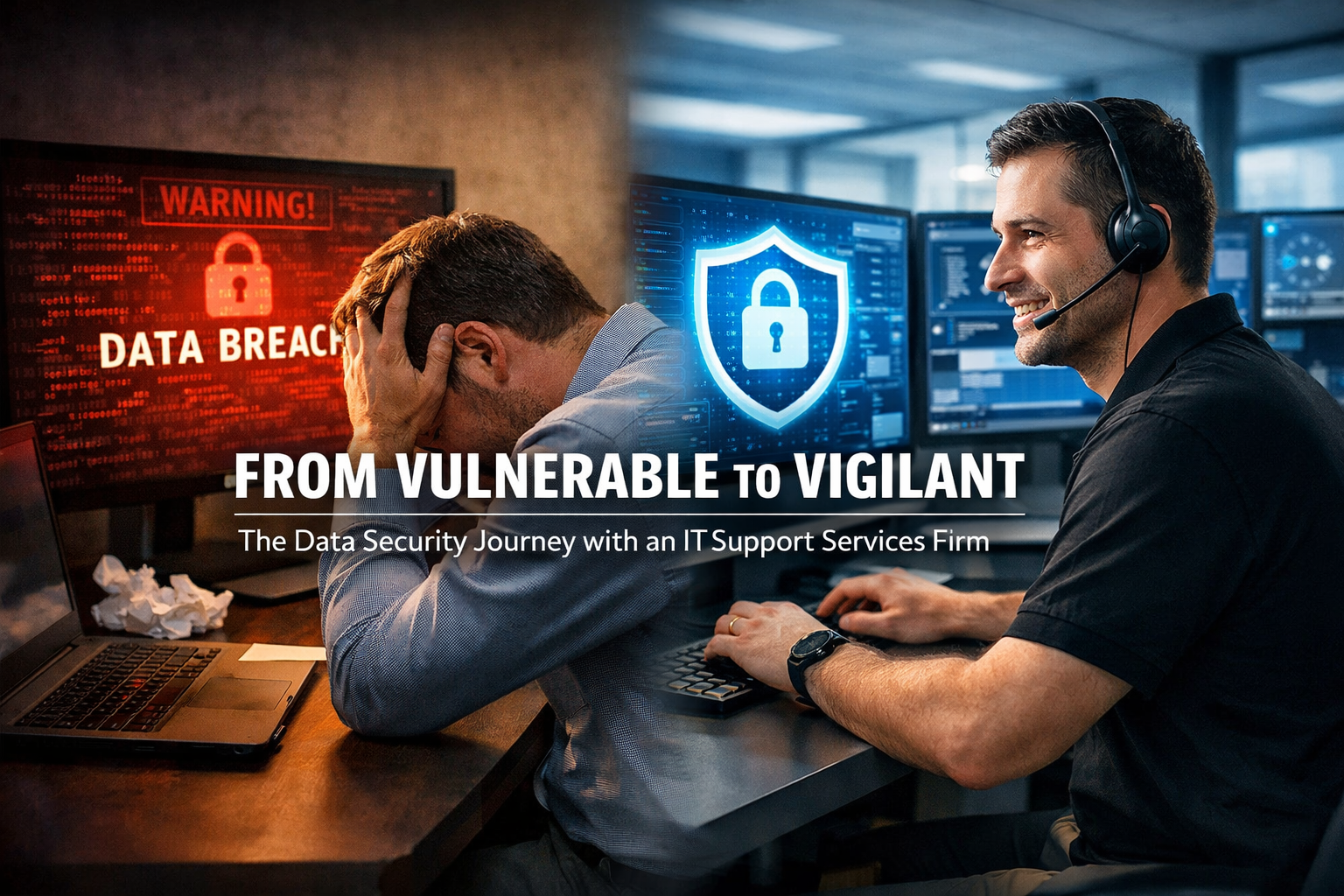
For the modern business owner, few things induce a pit in the stomach quite like the morning headlines. You see a competitor or a major corporation brought to its knees by ransomware, and the inevitable question arises: “Is my business next?” This anxiety is specific and valid. You aren’t just worried about a computer crashing; you are worried about payroll, client trust, and the very survival of the company you built.
The stakes have never been higher. The financial impact of a security failure is no longer just a line item for repair costs; it is a potential business-ending event. According to the 2024 Cost of a Data Breach Report, the global average cost of a data breach has reached $4.88 million. This figure underscores a harsh reality: data insecurity is not an IT inconvenience; it is a critical financial risk.
To navigate this landscape, businesses must fundamentally change how they view technology support. The old model of calling a technician only when a server smokes or a screen goes black is insufficient against modern threats. True security requires a shift from “fixing things when they break” to having a dedicated team watching the door 24/7. Many businesses remain stuck in a “break/fix” cycle, only addressing security after a disaster strikes. However, a true partner with a people-first MSP prioritizes your peace of mind by monitoring your systems 24/7 to neutralize threats before they escalate.
Key Takeaways
- Reactive IT is Risky: Relying on the “break/fix” model leaves dangerous gaps that automated cyber threats exploit, leading to costly downtime.
- Hybrid Work Requires New Tools: Securing a workforce that operates from home and coffee shops demands specific technologies like Multifactor Authentication (MFA) and secure internet gateways.
- The Human Element: With the majority of breaches involving human error, employee security training is just as vital as installing antivirus software.
- Resilience Over Prevention: A robust business continuity plan focuses on a hybrid backup strategy that prioritizes rapid recovery time, not just data storage.
Why Small Businesses Are the “Low-Hanging Fruit”
There is a persistent myth among Small to Mid-sized Business (SMB) owners that sounds something like this: “We are too small to be targeted. Hackers are looking for the big fish, like banks or retail giants.” This line of thinking is dangerous because it misunderstands the nature of modern cybercrime.
In reality, most attacks are not conducted by a person sitting in a dark room specifically choosing your company. They are conducted by automated bots that scour the internet indiscriminately, looking for open doors. These bots do not care if you are a Fortune 500 conglomerate or a 20-person architecture firm. If they find a vulnerability, they exploit it.
In fact, SMBs are often more attractive targets than large enterprises. While a small business might have fewer assets than a global bank, it also tends to have significantly weaker defenses. You likely hold valuable data—credit card numbers, social security numbers, and proprietary client records—but lack the enterprise-grade security operations center to protect it. To a cybercriminal, this makes you “low-hanging fruit.”
The consequences of falling for this myth are severe. The damage goes beyond the immediate ransom payment or IT repair bill. It involves reputation damage, legal fees, and lost revenue during downtime. The impact is so profound that, according to industry data, 60% of small businesses that suffer a significant cyberattack go out of business within six months. This statistic alone validates the anxiety many owners feel and highlights why “flying under the radar” is no longer a viable strategy.
The Shift: From “Break/Fix” to Proactive Vigilance
To protect against these threats, business owners must understand the two primary models of IT support: Break/Fix and Managed Services.
The Break/Fix model is the traditional way many small businesses handle IT. It functions much like a plumber or a mechanic: you pay someone to fix a problem after the damage is done. While this might seem cost-effective in the short term because you aren’t paying a monthly fee, it is inherently reactive. By the time you call for help, you are already losing money. Your server is already down, your employees are already idle, and the data breach may have already occurred. In this model, the IT provider profits when you have problems.
Contrast this with the Managed Service Provider (MSP) model, which is built on proactive vigilance. In this partnership, you pay a flat monthly fee for a team to monitor your network 24/7/365. The goal of an MSP is to align their success with yours; they are most profitable when your systems are running perfectly, not when they are fixing emergencies.
An MSP uses advanced monitoring tools to detect anomalies—like a failing hard drive or a suspicious login attempt—and neutralizes them before they escalate into business-stopping events. The business value here is twofold:
- Predictability: You can forecast your IT budget without fear of surprise emergency bills.
- Uptime: Your team stays productive because the systems they rely on are being maintained silently in the background.
Securing the Perimeter in a Hybrid World
A decade ago, securing a business was relatively simple: you put a firewall around the office, and everything inside was safe. Today, the “perimeter” has dissolved. Your employees are working from home, accessing files from hotel Wi-Fi, or checking email on personal smartphones. This flexibility is great for productivity, but it creates a massive headache for data security.
How do you secure data when it leaves the physical office?
This is where a managed IT partner proves their worth by securing “internet breakout points.” Regardless of where your employee is sitting, their connection to your company data needs to be verified and encrypted. An MSP implements layers of defense that travel with the user, ensuring safe connectivity whether they are at headquarters or a kitchen table.
Two specific components are critical in this hybrid environment:
1. Multifactor Authentication (MFA): Passwords are easily stolen or guessed. MFA adds a necessary layer of verification, such as a code sent to a phone or a biometric scan. It ensures that the person logging in is actually who they claim to be. In a remote world, MFA is not optional; it is the digital deadbolt on your front door.
2. Managed Cloud Security: As businesses migrate to platforms like Microsoft Azure and AWS, they often assume the cloud provider handles all security. This is a misconception. While providers secure the physical data center, you are responsible for securing access to your data. When you partner with a specialized IT support services firm to manage the complex configuration of these platforms, you gain the 24/7 proactive monitoring and modernized infrastructure needed to set proper access controls and defend against unusual activity.
By establishing these protocols, you ensure that your data remains protected even as your team remains mobile and productive.
The Human Firewall: Why Technology Alone Isn’t Enough
You can have the most expensive firewall in the world, but it can be bypassed by a single well-meaning employee clicking on the wrong link. This is the “human element” of cybersecurity, and it is the most difficult variable to control.
Cybercriminals know that hacking software is hard, but tricking people is easy. According to the 2024 Verizon Data Breach Investigations Report, 68% of breaches involve a non-malicious human element. This includes falling for phishing emails, misconfiguring settings, or simply sending sensitive data to the wrong recipient.
A strategic IT partner understands that technology alone isn’t enough. They view your employees not as the weakest link, but as the first line of defense—the “Human Firewall.”
An MSP manages this risk by providing ongoing security awareness training. This isn’t a once-a-year seminar that everyone ignores. It involves regular, bite-sized training modules and simulated phishing attacks to keep staff sharp. The goal is to create a culture of skepticism where an employee pauses before clicking a “Reset Password” link that looks slightly off. When your team knows what to look for, they become an active part of your security solution rather than a liability.
Resilience: The Safety Net of Backup and Recovery
Despite the best firewalls, the most vigilant monitoring, and the best-trained staff, 100% prevention is impossible. A determined attacker, a physical disaster (like a fire or flood), or a disgruntled employee can still cause data loss. Therefore, the ultimate goal of a data security journey is resilience.
Resilience answers the question: “If the worst happens, how quickly can we stand back up?”
This relies on a sophisticated backup strategy, often referred to as a “Hybrid Backup Strategy.” A managed IT partner will typically implement a system that combines:
- Local Backups: Data stored on an on-site appliance for lightning-fast restoration of accidentally deleted files.
- Cloud Backups: Encrypted copies of your data sent to secure off-site data centers. This ensures that even if your physical office is destroyed or your local servers are locked by ransomware, your data survives.
Crucially, an MSP focuses on Recovery Time Objectives (RTO). It’s not enough to simply have a backup; you need to be able to restore it quickly. If it takes three weeks to download your data from the cloud, your business might not survive the downtime. A partner ensures that your backups are verified, tested, and capable of restoring operations in hours, not days. Furthermore, they ensure this data is encrypted both “at rest” (where it is stored) and “in transit” (as it moves), keeping it useless to thieves even if they manage to intercept it.
How to Vet an IT Support Partner
Choosing the right Managed Service Provider is a business decision that requires due diligence. You are handing over the keys to your digital kingdom, so trust is paramount. Not all MSPs are created equal; some are simply break/fix shops disguised as a monthly invoice.
To ensure you are partnering with a firm that can truly protect you, ask the following questions during your vetting process:
- “Do you offer true 24/7 monitoring, or is it just 9-to-5?” Hackers don’t work banking hours.
- “What is your average response time?” You need to know how long you will wait when things go wrong.
- “How do you handle third-party vendor management?” Will they talk to your internet provider or software vendors for you?
- “Can you provide proof of your backup testing procedures?”
Finally, be wary of providers who try to lock you into long-term, inescapable contracts immediately. A confident partner should be willing to prove their value before binding you for years.
This is where trust signals matter. For example, Refresh Technologies offers a “90-Day Opt-Out Clause.” This allows clients to walk away penalty-free within the first three months if they aren’t satisfied. This level of transparency is rare in the industry and demonstrates that the firm is motivated to earn your business every single day, rather than relying on a legal contract to keep you paying.
Conclusion
Data security is not a product you buy once and put on a shelf; it is an ongoing journey. It requires a shift in mindset from reacting to disasters to proactively preventing them. It involves securing not just your servers, but your cloud infrastructure, your remote workforce, and the habits of your employees.
The transition from vulnerable to vigilant brings the one thing every business owner craves: peace of mind. When you know that experts are monitoring your perimeter, that your staff is trained to spot threats, and that your backups are tested and ready, you can stop worrying about the headlines and focus on growing your business. Don’t wait for a crisis to test your current IT setup. Assess your risks today and seek a proactive partnership that puts your security first
