
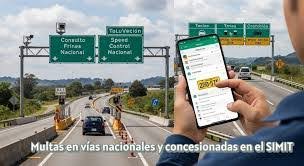
Arriving at a traffic office with all your documents and then discovering at the counter that you have an unpaid fine blocking your procedure — that costs time, money, and a wasted trip. Understanding the difference between SIMIT and RUNT helps avoid exactly that situation.
What is SIMIT and what information does it record?
SIMIT — Integrated System of Information on Traffic Fines and Sanctions — is Colombia’s national database of traffic tickets. It was created by Law 769 of 2002 and is managed by the Colombian Federation of Municipalities. Every fine issued in the country, from a photo ticket in Bogotá to a speeding violation in Pasto, is recorded in this system.
When an officer issues a ticket, SIMIT registers it within one to three business days. From that moment, the driver can check the balance, pay the fine, and download the payment receipt on the official portal of the Colombian Federation of Municipalities: www.fcm.org.co/simit.
Law 1383 of 2010 establishes discounts on fines. If payment is made within five business days after notification, the discount is 50%. If the driver first completes the mandatory traffic course, a 25% discount applies. After those deadlines, the full amount plus late interest must be paid.
An important point many drivers don’t know: SIMIT centralizes information from all municipalities in the country without exception. A ticket issued in Medellín will appear when the traffic authority in Cartagena checks your ID. The system operates nationwide. Searching by ID or using “SIMIT by Plate” is free and does not require prior registration.
What is RUNT and what is it for?
RUNT — National Traffic Registry — is Colombia’s official system for vehicle and driver identification. It was created by Law 1005 of 2006, regulated by Decree 019 of 2012, and operates under the supervision of the Ministry of Transport.
RUNT contains information such as the status of a driver’s license, vehicle registration, SOAT insurance validity, technical inspection results, and any legal restrictions or liens on the vehicle.
If you want to know whether a vehicle has a clean title before buying it, whether a license is valid, or if a car is reported stolen, that information is in www.runt.gov.co. The “RUNT by Plate” query provides the full legal profile of a vehicle — registration, insurance, inspection, and liens — just by entering the plate number. It is an essential tool before any buying or transfer process.
Unlike SIMIT, which deals only with financial debts from violations, RUNT does not record the value of fines. It focuses on the legal status of the driver and the vehicle, not outstanding debts.
How SIMIT and RUNT are connected — and why timing matters
The two systems communicate constantly. An unpaid fine in SIMIT automatically creates a restriction in RUNT. Without clearing your SIMIT record, no procedure can move forward in RUNT.
However, synchronization is not immediate:
- Online payments (PSE): 1 to 3 hours to update
- In-person payments: up to 72 business hours
- Holidays and weekends: delays are longer
This delay traps many drivers. They pay the fine and have the receipt, but RUNT still shows a restriction because the update hasn’t happened yet. Going to the office before the update means a wasted trip.
Solution: Confirm in RUNT that the restriction is gone before leaving home.
Procedures blocked by unpaid fines in SIMIT
Any outstanding balance in SIMIT blocks access to:
- Driver’s license issuance or renewal
- New vehicle registration
- Vehicle ownership transfer
- Vehicle modifications
- Duplicate license or registration card
- License category upgrade
- Professional driver certification
- Enrollment in driving school courses
- Vehicle export authorization
Important note: If the fine is linked to the vehicle’s plate, the transfer is blocked even if the buyer has no debts. Both buyer and seller must have a clean SIMIT record. Partial payments do not unlock anything — the balance must be zero.
How to check SIMIT and RUNT before going to a traffic office
1 Check SIMIT first
Go to www.fcm.org.co/simit. Search by ID or use “SIMIT by Plate.” Review all listed fines.
2 Pay what you owe and save the receipt
Payments can be made online or at authorized locations. Always keep proof.
3 Wait for synchronization
Online: 1–3 hours
In person: up to 72 business hours
4 Confirm in RUNT
Check that no restrictions remain before visiting the office.
5 Proceed with your procedure
If restrictions still appear after the waiting period, contact the relevant traffic authority.
Can RUNT show suspensions not listed in SIMIT?
Yes — and this causes confusion.
SIMIT only records financial penalties (fines). RUNT independently records license suspensions due to accumulated points under Law 1383 of 2010. A driver can have zero balance in SIMIT and still have a suspended license in RUNT.
If a problem appears in your license but you have no fines, check RUNT directly. It’s not a system error — the two systems serve different legal purposes.
Suspension duration depends on accumulated points and whether required courses are completed. It can range from months to permanent cancellation.
How often should you check both systems?
There’s no fixed schedule, but it’s essential:
- Before any traffic procedure
- Before buying or selling a vehicle
- At least one week in advance
Both SIMIT and RUNT also have free mobile apps for basic checks.
Conclusion
Before any traffic-related procedure in Colombia, always follow this sequence:
Check SIMIT → pay fines → wait for synchronization → confirm in RUNT.
Use “SIMIT by Plate” if you only have the plate number, and “RUNT by Plate” to review a vehicle’s legal history before buying. Always check at least one week in advance — what seems urgent rarely justifies skipping verification.
