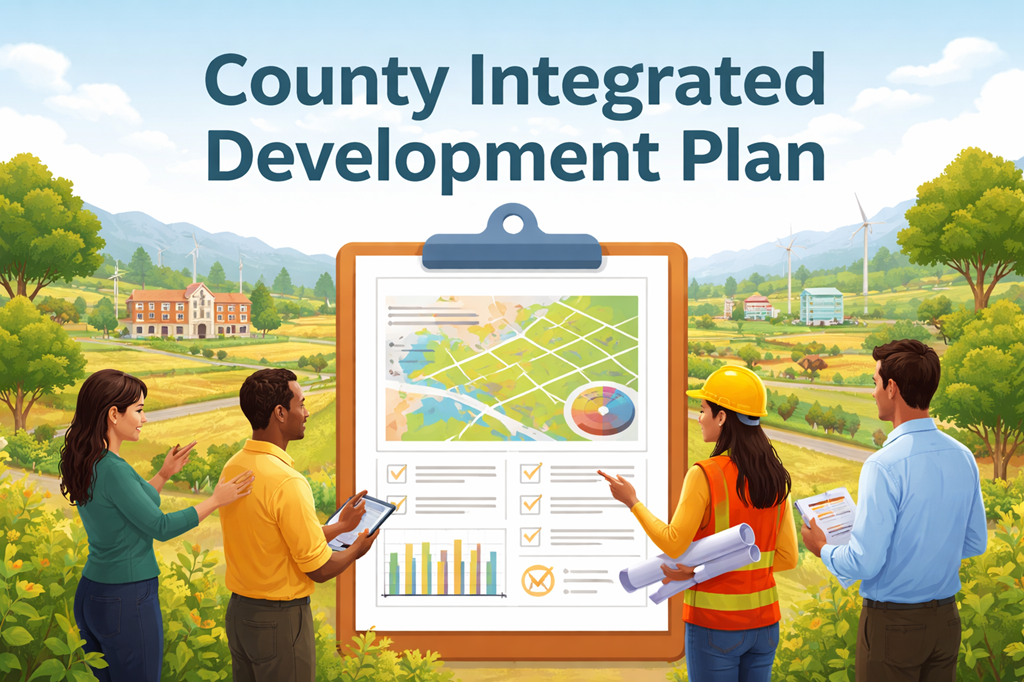
A County Integrated Development Plan, widely known as a CIDP, is the main long term planning framework that guides how a county develops, spends public resources, and delivers services to its people. It sets priorities, aligns sector plans, connects development goals to budgets, and provides a clear direction for action over a defined period, usually five years.
In simple words, a County Integrated Development Plan explains where a county is, where it wants to go, and how it will get there, while ensuring decisions are coordinated, inclusive, and accountable.
This article is written as a complete and practical guide. It explains the CIDP clearly, from meaning and purpose to preparation, implementation, and real world impact.
What a County Integrated Development Plan Really Means
A County Integrated Development Plan is not just a document prepared to meet a legal requirement. It is the foundation of county governance and development planning.
It brings together:
- Development goals and priorities
- Sector strategies and programs
- Budget planning and resource allocation
- Community needs and public input
- Monitoring and accountability systems
When these elements are planned separately, counties face duplication, wasted resources, and uneven development. A CIDP solves this by placing all planning decisions within one shared framework.
Why the Plan is Called Integrated
The word integrated describes how the plan is designed and used.
Integration means that all major sectors are planned together rather than in isolation. Health, education, roads, water, housing, agriculture, environment, trade, and governance are treated as connected systems.
For example, improving a rural road is not only a transport decision. It affects market access, school attendance, healthcare access, and local incomes. A CIDP recognizes these links and plans them together.
This integrated approach helps counties avoid duplicated projects, align timelines, and achieve stronger results with limited resources.
The Legal and Governance Role of a CIDP
In many devolved systems, including Kenya, a County Integrated Development Plan is a legal requirement.
The law expects counties to:
- Prepare a five year development plan
- Use it as the basis for budgeting and spending
- Include clear implementation arrangements
- Provide monitoring, evaluation, and reporting mechanisms
- Involve the public meaningfully in planning
Because of this, the CIDP becomes the official reference point for development decisions, oversight, and accountability.
Why Counties Depend on a County Integrated Development Plan
Providing long term direction
Counties face constant pressure to respond to short term needs. A CIDP creates stability by setting a shared long term vision that guides decisions even when leadership changes.
Improving use of public resources
Public funds are limited. A CIDP helps counties prioritize projects with the greatest social and economic benefit and avoid scattered spending.
Strengthening accountability
When goals and targets are defined in advance, progress can be measured. Citizens and oversight bodies can compare promises with actual delivery.
Supporting inclusive development
Public participation is a core part of CIDP preparation. This ensures development priorities reflect real community needs, not only administrative preferences.
Core Objectives of a County Integrated Development Plan
A well designed CIDP aims to achieve several outcomes at the same time.
Socio economic improvement
The plan seeks to reduce poverty, create jobs, and improve living standards by strengthening local economies and services.
Effective service delivery
Health, education, water, sanitation, and infrastructure services are planned based on evidence and long term demand.
Sustainability and resilience
Economic growth is balanced with environmental protection and responsible use of natural resources.
Equity and inclusion
The plan pays attention to underserved areas and vulnerable groups, including women, youth, persons with disabilities, and marginalized communities.
Key Principles that Guide a Strong CIDP
Integration across sectors
Projects and programs should reinforce each other rather than compete.
Evidence based planning
Decisions are informed by data, analysis, and clear understanding of county conditions.
Participation and ownership
Residents are involved as partners in shaping development priorities.
Realism and feasibility
Targets and projects are aligned with available funding and institutional capacity.
Transparency
Planning choices and trade offs are clearly explained and open to public review.
Main Components of a County Integrated Development Plan
Although formats differ, strong CIDPs usually include the following elements.
County profile and baseline context
This section describes the current situation of the county.
It often includes:
- Population trends and settlement patterns
- Economic activities and livelihoods
- Poverty levels and inequality
- Infrastructure and service coverage
- Environmental conditions and risks
- Institutional capacity and governance
This baseline is important because it becomes the reference point for measuring progress.
Situational analysis
The situational analysis explains what is working and what is not.
It identifies development gaps, key challenges, opportunities, and risks that must be addressed during the planning period.
Vision, mission, and development pillars
The vision presents the desired future of the county in clear and simple terms.
Development pillars group priorities into broad themes such as health, infrastructure, economic development, human capital, environment, and governance.
Strategic priorities and sector plans
Each major sector outlines:
- The main problems
- The strategic response
- Planned programs and interventions
- Expected results
Integration is shown by how sector actions support shared county outcomes.
Program and project portfolio
This section turns strategy into action.
It lists priority programs and projects with:
- Cost estimates
- Implementation timelines
- Responsible departments
- Expected outputs and outcomes
This clarity makes budgeting and monitoring possible.
Implementation framework
The implementation framework explains how the plan will be delivered.
It defines roles, coordination mechanisms, partnerships, and capacity needs across departments and institutions.
Monitoring, evaluation, and reporting
Clear indicators and reporting schedules are set to track progress and assess impact.
This ensures the CIDP remains a living framework rather than a static report.
How a County Integrated Development Plan is Prepared
Organizing the planning process
The county establishes a planning team, sets timelines, and identifies stakeholders.
Building the evidence base
Data is collected from administrative records, sector reports, spatial information, and community input.
Public participation
Citizens, civil society, and private sector actors share priorities through forums, meetings, surveys, and written submissions.
Prioritization and drafting
Issues are ranked based on need, impact, feasibility, and available resources. A draft plan is prepared and reviewed.
Approval and adoption
The final CIDP is approved through the required county processes, giving it official status.
The Role of public participation in a CIDP
Public participation improves both legitimacy and effectiveness.
When communities are involved:
- Priorities reflect real needs
- Projects are better designed
- Implementation faces less resistance
- Trust in county government increases
Effective participation is inclusive, accessible, and transparent about how public input influenced decisions.
Linking the CIDP to Annual Plans and Budgets
A CIDP sets long term direction, but budgets deliver results.
Counties usually translate the CIDP into:
- Annual development plans
- Medium term expenditure frameworks
- Sector budgets
This link ensures yearly spending supports long term goals rather than short term pressures.
Monitoring and Evaluating CIDP Implementation
Why monitoring matters
Even strong plans fail without follow through.
Monitoring helps counties identify delays early, adjust strategies, and improve accountability.
Common monitoring tools
- Performance indicators
- Annual progress reports
- Mid term reviews
- Independent evaluations
Transparent reporting allows citizens to see how public resources are used.
Common Challenges in CIDP Development and Use
Limited financial resources
Ambitious plans may exceed available funding.
Capacity and skills gaps
Planning, monitoring, and project management skills may be uneven.
Weak coordination
Departments may continue to work in silos despite an integrated plan.
Political pressure
Short term interests can undermine long term priorities.
Recognizing these challenges helps counties design more realistic and resilient plans.
How a Strong CIDP Improves Daily Life
When properly implemented, a County Integrated Development Plan leads to visible improvements.
These include:
- Better access to health and education
- Improved roads, water, and sanitation
- Stronger local economies and job creation
- More balanced urban and rural development
- Better protection of natural resources
Most importantly, it creates a shared sense of direction between government and citizens.
The County Integrated Development Plan as a Living Framework
A CIDP should evolve as conditions change.
Economic shifts, population growth, climate risks, and new opportunities require regular review and adjustment.
Counties that treat the CIDP as a living framework gain long term benefits in governance, service delivery, and public trust.
Final Perspective
A County Integrated Development Plan is the foundation of effective county planning and governance. It aligns vision with action, connects budgets to priorities, and turns development goals into coordinated programs.
When grounded in evidence, shaped by public participation, and implemented with discipline, a CIDP becomes more than a plan. It becomes the shared roadmap that guides a county toward inclusive, sustainable, and accountable development.