
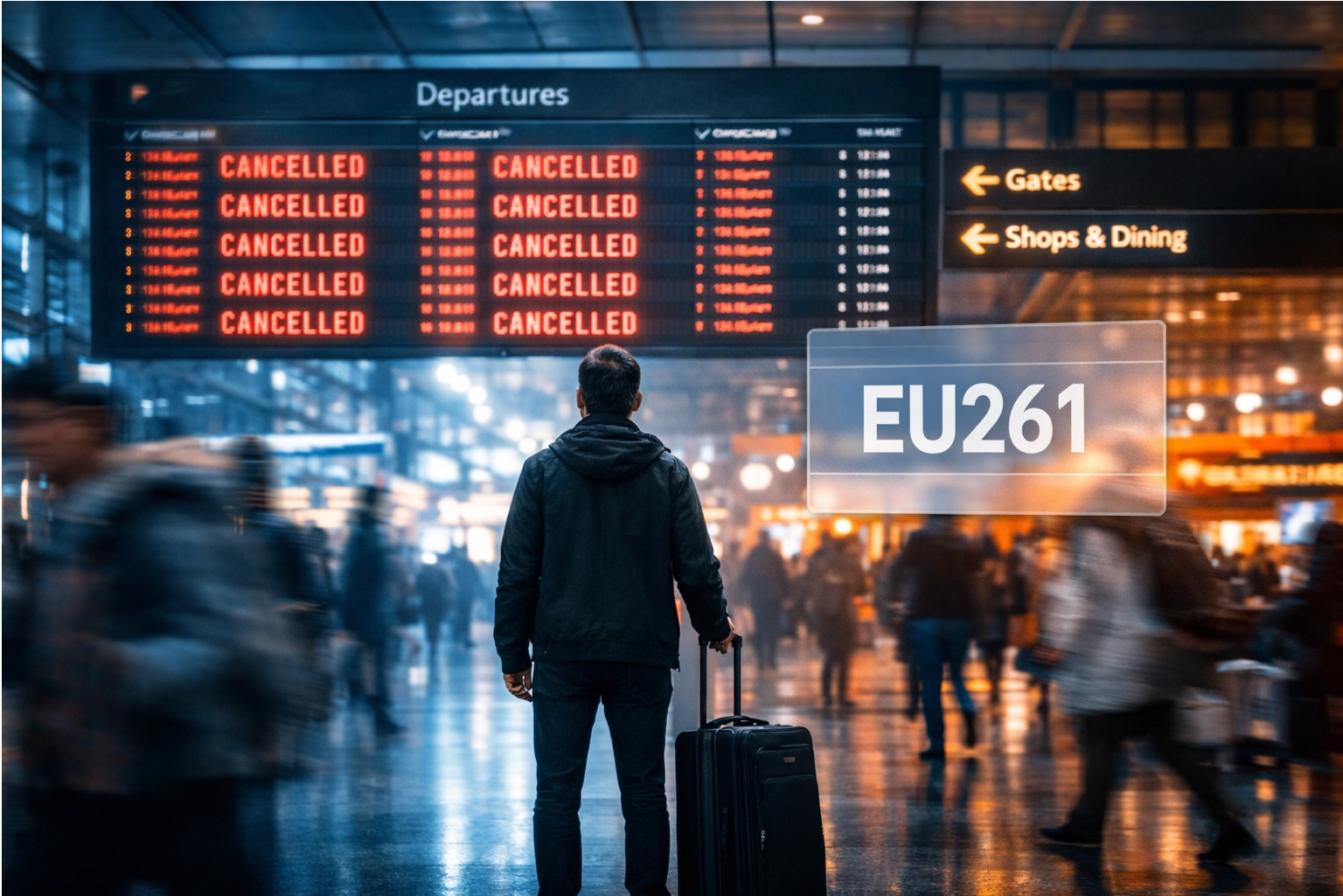
You are running late for a connecting flight. The departure board flips to “Cancelled.” Your stomach drops, and so does your weekend. Most passengers in this situation accept a voucher, shrug, and move on. What they do not realize is that EU261 passenger rights, may entitle them to up to €600 in cash compensation. No voucher. No goodwill gesture. Actual money.
This guide breaks down everything you need to know about Regulation EC 261/2004, who qualifies, what you are owed, and how to claim it without hiring a lawyer.
What Is EU261 and Why Does It Exist?
EU Regulation 261/2004, commonly known as EU261, is a piece of European Union legislation designed to protect air passengers from the financial and personal disruption caused by flight delays, cancellations, and boarding denials. It came into force in February 2005 and remains one of the strongest air passenger protection frameworks in the world.
The regulation applies to millions of flights each year, yet industry surveys consistently show that fewer than 3% of eligible passengers actually file a claim. That gap exists almost entirely because of awareness — not eligibility.
Which Flights Are Covered Under EU261 Passenger Rights?
Understanding coverage is the first checkpoint in your eligibility checklist. EU261 covers your flight if it departs from any airport within the European Union, regardless of the airline operating it. It also covers flights arriving into the EU on a European carrier — meaning an airline headquartered in an EU member state.
So if you fly from Lisbon to New York on TAP Air Portugal, you are covered in both directions. If you fly from New York to Lisbon on United Airlines, only the return leg qualifies under EU261 voos rules.
Switzerland, Norway, and Iceland also fall under this regulation despite not being EU members, thanks to their membership in the European Economic Area.
The Core Checklist: Do You Qualify to Claim?
Step One — Confirm Your Disruption Type
EU261 compensation applies to three categories of disruption. The first is a flight delay of three hours or more at your final destination. The second is a flight cancellation with less than 14 days’ notice. The third is an involuntary denied boarding, which occurs when you are bumped from a flight you were confirmed and checked in for — not because of anything you did, but due to overbooking or operational reasons.
Step Two — Check the Cause of the Disruption
This is where many claims fall apart — but only when passengers do not push back hard enough. Airlines are exempt from paying compensation if the disruption was caused by extraordinary circumstances: events beyond their reasonable control, such as severe weather, political instability, airport strikes unrelated to the airline, or hidden manufacturing defects.
However, airlines frequently misuse this exemption. A technical fault caused by poor maintenance is not extraordinary. A strike by the airline’s own staff is not extraordinary. An ATC restriction that applies only to your airline is not extraordinary. If an airline cites extraordinary circumstances, you are entitled to ask for documented proof.
Step Three — Calculate Your Compensation Amount
The amount owed under EU261 passenger rights follows a distance-based sliding scale. For flights up to 1,500 kilometres, the standard compensation is €250 per passenger. For intra-EU flights over 1,500 kilometres and all other flights between 1,500 and 3,500 kilometres, the amount rises to €400. For flights exceeding 3,500 kilometres, the compensation reaches €600 per person.
These figures apply per passenger, not per booking. A family of four on a cancelled long-haul flight could be entitled to €2,400 in total.
Right to Care: What Airlines Must Provide Immediately
Beyond monetary compensation, EU261 also guarantees a “right to care” that kicks in immediately when your flight is disrupted. If your departure is delayed by two hours or more, the airline must provide meals and refreshments proportional to the waiting time, two free telephone calls or emails, and hotel accommodation if an overnight stay becomes necessary.
Many passengers accept meal vouchers without realizing they are also entitled to rebooking on the next available flight — even with a competing carrier — or a full refund if they choose not to travel at all.
How to File an EU261 Claim Effectively
Filing a claim starts with documentation. Keep your boarding passes, take screenshots of departure board updates, and request a written explanation from the airline at the airport. When you submit your claim, address it directly to the airline’s customer relations department in writing, citing Regulation EC 261/2004 explicitly.
Airlines are required to respond within a reasonable period. If they reject your claim or go silent, you can escalate to the National Enforcement Body in the country where the disruption occurred. In Portugal, this body is ANAC. In the UK (for flights before January 2021), it is the CAA. These bodies can compel airlines to pay without litigation.
Final Thoughts
EU261 passenger rights exist precisely because flight disruptions are not just inconveniences, they cost passengers time, money, and missed opportunities. Understanding whether your voos qualify takes less than five minutes with the checklist above. The compensation process, while sometimes slow, is well-established and entirely within your reach.
The next time a screen shows “Delayed” or “Cancelled,” do not reach for a voucher. Reach for your rights.
Frequently Asked Questions About EU261 Voos
How long do I have to file an EU261 claim?
The time limit varies by country but is typically between two and six years from the date of the disrupted flight. In Portugal and most EU member states, the standard limitation period is three years. Do not assume you have missed your window — check the rules specific to your departure country.
Can I claim if I was travelling on a free ticket or using miles?
Yes. EU261 applies to all confirmed reservations, including award tickets booked with frequent flyer miles, complimentary upgrades, and promotional fares. The ticket price is irrelevant to your right to compensation.
What if the airline blames air traffic control for the delay?
A general ATC restriction affecting the entire airport or region can qualify as extraordinary circumstances. However, an ATC slot restriction applied specifically to your airline due to scheduling or administrative reasons does not. Request the airline’s written statement and cross-reference it with publicly available ATC delay data if possible.
Does EU261 apply to charter or low-cost flights?
Yes. The regulation applies regardless of the commercial model of the airline. Ryanair, easyJet, Wizz Air, and all other low-cost carriers operating within the EU are subject to the same compensation rules as full-service airlines.
