
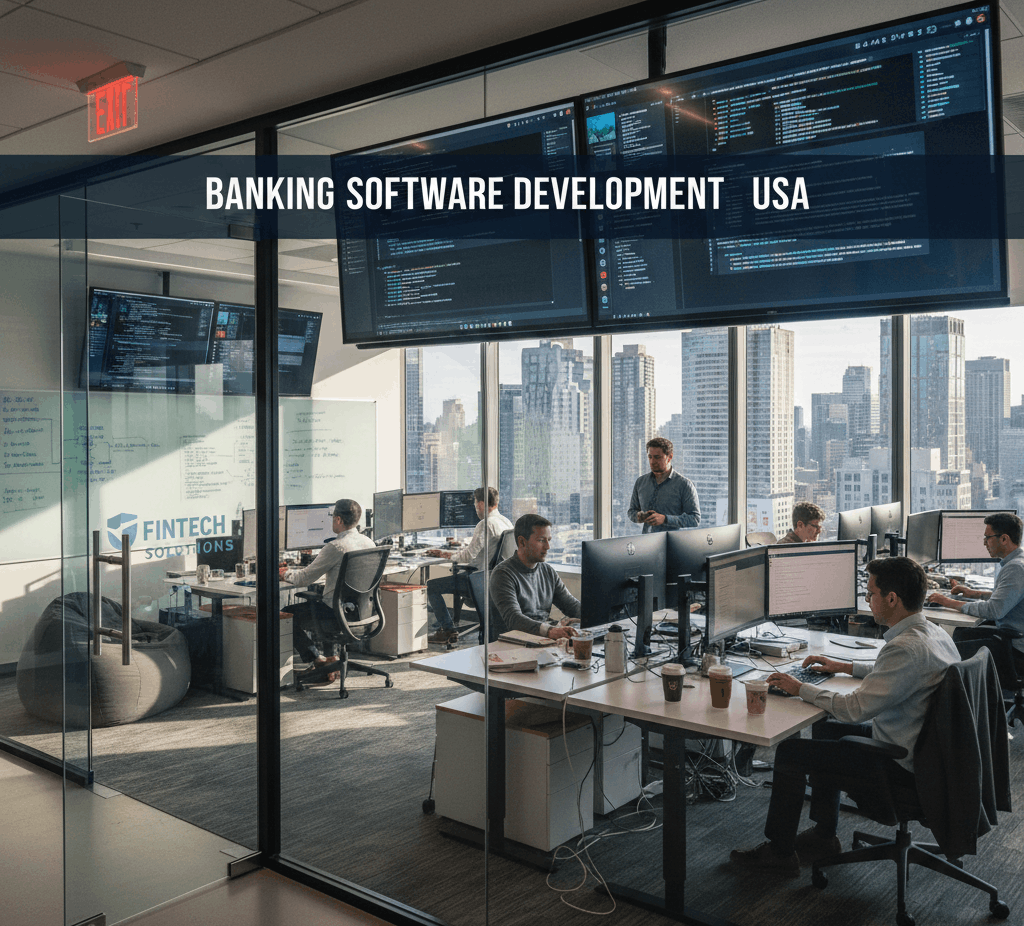
The US banking sector is undergoing one of the most significant technology transformations in its history. Driven by evolving customer expectations, regulatory pressure, cybersecurity threats, and competition from fintechs, banks and financial institutions across the United States are rethinking how they build, modernize, and scale their digital systems.
At the center of this transformation lies banking software development—not just as a technical function, but as a strategic capability. From core banking platforms and digital payment systems to risk management tools and customer-facing applications, modern banking software must be secure by design, compliant with US regulations, and scalable enough to support future growth.
This article explores how banks approach banking software development in the USA, why security and compliance are non-negotiable, and how scalable architectures enable long-term success.
The Current State of Banking Software Development in the USA
The US financial ecosystem is one of the most complex and regulated in the world. Unlike many global markets, American banks must navigate a layered regulatory environment involving federal, state, and industry-specific authorities. At the same time, customers expect seamless digital experiences comparable to those offered by leading technology companies.
As a result, banking software development in the USA has shifted away from monolithic, legacy-heavy systems toward modular, API-driven architectures, cloud and hybrid infrastructure, security-first development practices, and compliance-aligned software lifecycles. Banks are no longer just upgrading systems—they are rebuilding technology foundations to support innovation without compromising trust.
Why Security Is the Foundation of US Banking Software
Security is not an add-on in US banking software—it is a baseline requirement. Financial institutions handle highly sensitive data, including personally identifiable information, transaction records, and authentication credentials. Any vulnerability can lead to financial loss, reputational damage, and regulatory penalties.
Modern banking platforms rely on secure software architectures that include network security, application-level controls, data encryption at rest and in transit, and secure API gateways. This layered approach reduces attack surfaces and limits the impact of potential breaches.
Identity and access management also plays a critical role. Strong IAM frameworks ensure users access only what they are authorized to, privileged access is tightly controlled, and multi-factor authentication is enforced. These measures are essential for meeting both security and compliance expectations in the US market.
Continuous threat monitoring further strengthens security posture. US banks increasingly rely on real-time logging, automated threat detection, and centralized monitoring tools to identify and respond to incidents before they escalate.
Compliance as a Core Requirement in the US Market
Compliance directly influences how banking software solutions in the USA are designed and deployed. Unlike generic enterprise applications, banking systems must meet strict regulatory standards that affect data handling, reporting, and audit readiness.
Key regulations shaping US banking software include the Gramm-Leach-Bliley Act for customer data protection, the Sarbanes-Oxley Act for financial transparency, PCI DSS for payment security, and FFIEC guidelines for IT and cybersecurity controls. These regulations translate into specific software requirements, such as detailed logging, access controls, encryption, and traceability.
Compliance-Driven Development Practices
To meet regulatory expectations, US banks embed compliance directly into the software development lifecycle. Compliance-by-design ensures regulatory requirements are considered during architecture and design phases, not added later as patches.
Audit-ready systems are built with comprehensive logs and reporting mechanisms to support regulatory examinations. Data governance frameworks define how information is stored, accessed, and retained, while automated compliance checks reduce human error and ensure consistency across environments.
By aligning development practices with compliance from the outset, banks reduce operational risk and avoid costly system rework.
Scalability as a Strategic Requirement
Scalability is a critical component of banking software development in the USA. Banks must support fluctuating transaction volumes, rapid customer growth, and the introduction of new digital services without compromising performance or availability.
Seasonal spikes, such as holiday transactions or tax season activity, place additional stress on systems. Scalable architectures ensure consistent performance during peak demand and allow banks to grow without repeated infrastructure overhauls.
Architectures That Support Scalable Banking Systems
US banks increasingly adopt modern architectures to support scalability and resilience. Microservices architectures break large systems into independent services, allowing specific components to scale without affecting the entire platform. This improves deployment speed and fault isolation.
Cloud and hybrid infrastructure models are widely used, enabling banks to keep sensitive workloads on-premises while leveraging cloud scalability for analytics, customer-facing applications, and development environments. API-first development further enhances flexibility by enabling seamless integration with fintech partners, payment platforms, and open banking ecosystems.
The Role of Banking Technology Consulting
As banking systems grow more complex, institutions rely on banking technology consulting to guide modernization efforts. Consulting services help banks align business objectives with technical execution while navigating regulatory constraints.
Typical consulting engagements include technology roadmap planning, legacy system modernization, cloud adoption strategies, security and compliance assessments, and platform selection. For US banks, this guidance ensures innovation efforts remain compliant and risk-aware.
Legacy System Modernization in US Banking
Many US banks continue to operate on legacy core systems that were built decades ago. While these platforms offer stability, they often lack the flexibility needed to support modern digital services.
Legacy systems can increase maintenance costs, slow product innovation, and complicate integration with modern security tools. Rather than pursuing risky full replacements, banks adopt phased modernization strategies.
Common approaches include incrementally replacing system components, enabling APIs around legacy platforms, and running new and old systems in parallel during transition periods. These methods reduce disruption while improving agility and scalability.
Data Management and Analytics Capabilities
Data plays a central role in modern banking software, supporting fraud detection, risk management, regulatory reporting, and personalized customer experiences. US banking platforms must process transactions in real time while maintaining strict data governance and privacy controls.
Advanced analytics, secure data warehouses, and AI-driven insights enable banks to make informed decisions while remaining compliant with regulatory expectations. Balancing innovation with responsible data usage is a key challenge for US institutions.
Customer Experience as a Competitive Advantage
While security and compliance are mandatory, customer experience increasingly differentiates US banks in a crowded market. Consumers expect fast, intuitive, and reliable digital services across all channels.
Modern banking software supports omnichannel experiences, personalized dashboards, real-time alerts, and seamless onboarding. Well-designed systems improve customer satisfaction while reducing operational friction.
Selecting the Right Development Partner
Choosing the right development partner is critical for successful banking software initiatives. US banks must look beyond technical expertise and evaluate a partner’s understanding of regulatory requirements, security standards, and financial risk management.
Strong partners demonstrate experience in financial services, proven security and compliance practices, scalable architecture capabilities, and clear documentation for audits and governance.
Future Trends in US Banking Software Development
Several trends will continue shaping banking software development in the USA. These include greater adoption of artificial intelligence, expansion of open banking APIs, zero-trust security models, and continued modernization of core banking platforms.
Banks that invest in adaptable, compliant, and scalable systems today will be better positioned to respond to regulatory changes and evolving customer expectations.
Conclusion
Banking software development in the USA is a strategic priority for financial institutions navigating digital transformation. Security and compliance form the foundation of trustworthy systems, while scalability ensures long-term growth and resilience.
By adopting modern architectures, embedding compliance into development practices, and leveraging banking technology consulting, US banks can modernize their platforms without compromising stability or trust. As competition intensifies, software excellence will remain a defining factor in the future of American banking.
