
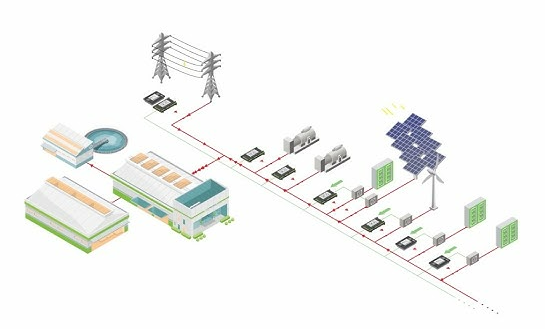
In grid compatibility and grid compliance validation, load simulation is widely used to reproduce how electrical equipment interacts with the grid under defined operating conditions. Typical equipment under test (EUT) includes grid-connected inverters, distributed energy resources (DER), EV chargers, and other power conversion systems evaluated according to standards such as the IEC 61000 series and IEEE 1547.1.
In these test configurations, the load is not merely a power sink. Instead, it forms part of the electrical boundary conditions that directly influence voltage stability, current dynamics, and system behavior during steady-state operation, transients, and disturbance recovery. As a result, the type of load used, dissipative or regenerative, has a direct impact on the physical validity of the test.
Dissipative Load versus Regenerative Load
A dissipative load absorbs electrical energy and converts it into heat. In contrast, a regenerative load absorbs power from the EUT and returns it to the grid or a common DC bus while maintaining controlled voltage and current characteristics.
From an energy flow perspective:
- Dissipative load:
P_absorbed → P_thermal - Regenerative load:
P_absorbed → P_grid (bidirectional power flow)
Although this difference is often discussed in terms of efficiency and heat dissipation, its more significant implication lies in dynamic interaction and test realism, particularly in grid-related validation scenarios.

Dynamic Power Behavior During Grid Disturbances
In grid compatibility testing, the EUT rarely operates under static conditions. During voltage dips, frequency deviations, phase jumps, or recovery events, the direction and magnitude of power flow may change rapidly.
The instantaneous power exchanged between the EUT and the test system can be expressed as:
P(t) = v(t) · i(t)
During a voltage dip defined in IEC 61000-4-11, for example, a grid-connected inverter may reduce active power injection or modify its current reference. Upon voltage recovery, transient overshoot in current or power is common due to control loop dynamics.
If the load cannot accept regenerated power or respond fast enough to these transitions, the observed behavior may reflect limitations of the test setup rather than the true response of the EUT. A regenerative load maintains stable electrical conditions while allowing bidirectional energy flow, preserving realistic boundary conditions during fast transients.
Impact on Grid Impedance Representation and Stability
In many grid compatibility tests, the load contributes to the apparent grid impedance seen by the EUT. For a simplified single-phase system:
Z_grid,eq = V_PCC / I_EUT
A dissipative load with limited dynamic response may unintentionally introduce artificial damping or delay, masking control instabilities such as oscillations in current control loops or phase-locked loops (PLL).

A regenerative load, when properly controlled, can maintain a more realistic and stable grid-side response, allowing instability mechanisms to manifest as they would under real grid interaction.
This aspect is critical when validating:
- Control loop stability
- PLL robustness
- Fault ride-through performance
- Power recovery behavior after grid disturbances
Energy Balance in Long-Duration and High-Power Testing
Grid compatibility validation often involves long-duration testing, especially when evaluating thermal stability, endurance, or repeated disturbance sequences.
For a test with average absorbed power P_avg over a duration T, the total absorbed energy is:
E = P_avg · T
At high power levels, dissipative loads impose practical limitations due to heat dissipation, cooling requirements, and facility constraints. Regenerative loads remove these constraints by returning energy to the grid, enabling extended test durations without altering the electrical behavior of the system under test.
Relevance to Standards-Based Validation
Although grid standards rarely mandate the use of regenerative loads explicitly, they implicitly assume that the test system does not influence test results.
For example:
- IEC 61000-4-13 requires harmonic and interharmonic voltages to be superimposed while maintaining defined RMS voltage levels.
- IEEE 1547.1 evaluates EUT behavior under abnormal grid conditions where bidirectional power flow may occur during transitions.
Meeting these requirements consistently is significantly easier when the load can absorb and regenerate power without disturbing voltage regulation or waveform integrity.
When a Regenerative Load Becomes Essential
The use of a regenerative load becomes essential when:
- The EUT exhibits strong bidirectional power flow
- High-power or long-duration testing is required
- Dynamic grid interaction and recovery behavior are under evaluation
- Test repeatability and boundary-condition neutrality are critical
In these cases, a regenerative load is not an efficiency upgrade but a prerequisite for physically meaningful grid compatibility validation.
Conclusion
In grid compatibility testing, load simulation defines how faithfully the test environment represents real grid interaction. Regenerative loads matter not because they reduce energy consumption, but because they preserve correct electrical behavior under dynamic, bidirectional operating conditions.
By maintaining realistic power flow, stable impedance characteristics, and fast dynamic response during disturbances and recovery, regenerative loads ensure that observed EUT behavior reflects true system performance rather than artifacts introduced by the test setup. The above context studies from a quantitative perspective how regenerative load achieves cost-effectiveness with power testing, if you are looking for programmable load simulation equipment for these testing applications you may also visit the website of ActionPower for more information who is a expert in this field.
